ENVIRONMENTAL DESIGN
A Logo Was Not Going to Do
The project started with someone asking if a logo could be put in a lobby. What the team delivered was something else entirely.
Office space had been acquired in a building owned and occupied by another large corporation, and that created an immediate identity problem. Employees arriving each day were walking into someone else's building, surrounded by someone else's brand. A logo on the wall wasn't going to change that. What was needed was an environment so thoroughly and specifically the pharmaceutical company's own that the building around it became irrelevant.
The objective was communication at scale: to bring the history, legacy, present, and future of one of the world's most significant pharmaceutical companies to life for employees who had no visibility into any of it.
The project received three industry awards in the category of environmental design.
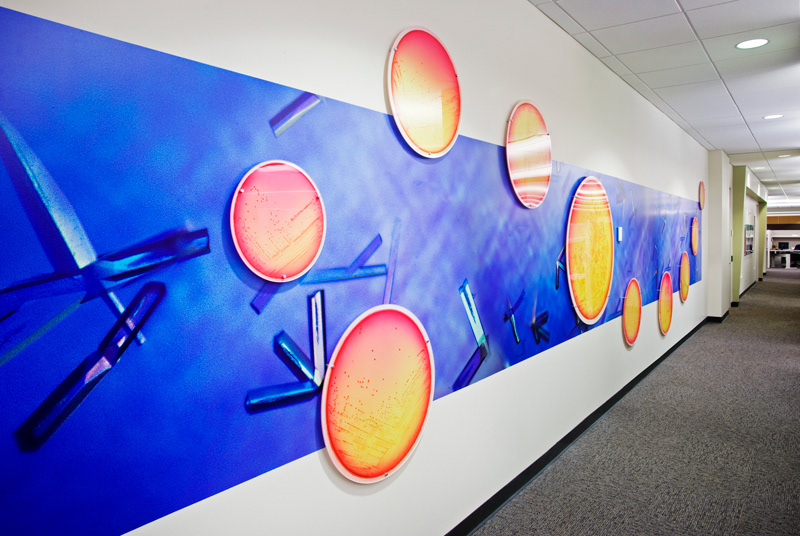
Petri dish wall installation with photomicrograph mural
The first image answered the question of how you make a leased office space feel like it belongs to a pharmaceutical company , and the answer was not a logo. A full-length corridor wall became the installation's centerpiece: a vivid photomicrograph of an AIDS inhibitor, populated with dimensional circular petri dish pieces mounted at varying sizes and depths. The effect was immediate and unmistakable, science, brought out of the lab and onto the walls, rendered at a scale that transformed a standard office corridor into something worth stopping to look at.
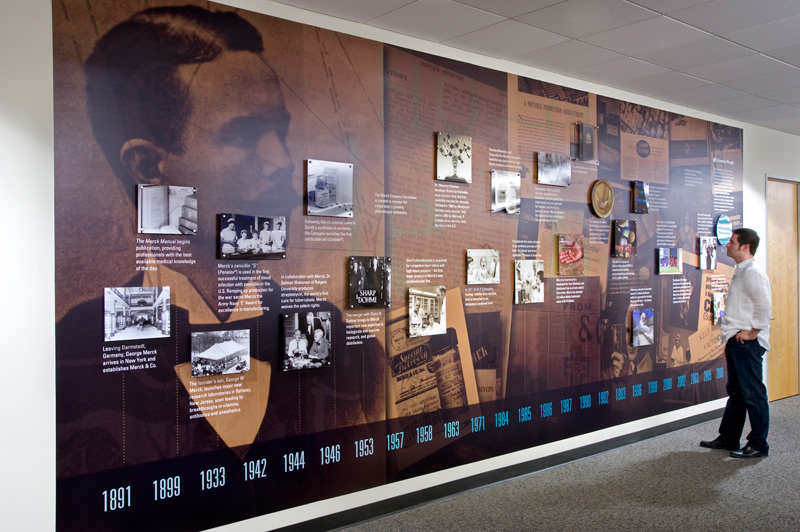
Heritage timeline wall - 118 years of company history
The heritage wall was the narrative backbone of the installation, and the most ambitious single element in the space. Spanning the full length of a large wall, it carried 118 years of company history in a single continuous composition: a rich sepia-toned field layered with archival photographs, newspaper headlines, product imagery, medallions, and milestone copy spanning dates from 1891 through the present day. A large-scale portrait of an early company figure anchored the left edge, his gaze drawing visitors into the timeline that unfolded beside him. Dimensional acrylic-mounted photographs floated off the surface at intervals, adding depth and a curatorial quality that elevated the installation well beyond a printed graphic.

Lounge area - photomicrograph mural, informal seating
The photomicrograph design language carried into every shared space in the installation, including the informal lounge areas where employees gathered to talk, take a break, and decompress. A full-wall mural in deep violet and magenta filled the alcove behind the seating. The mural wrapped the architectural soffit above as well, extending the image into the ceiling plane and making the entire nook feel immersed in the science rather than merely adjacent to it.
Research and manufacturing mural with dimensional scientist panels
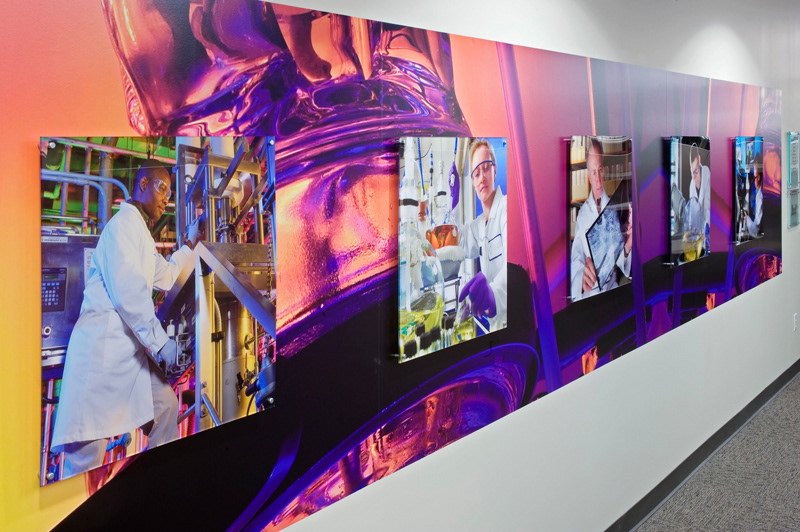
A second major corridor wall extended the installation's visual language with a different emphasis, shifting from history to the present-day science driving the company forward. A sweeping full-length mural filled the wall. Mounted on standoffs across the mural's surface, a series of acrylic-mounted photographs depicted scientists and researchers at work - in manufacturing facilities, in laboratories, at equipment that most employees in this office would never otherwise see.

Heritage collage wall - archival photography montage spanning company history
A sweeping montage of archival imagery layered and composed across the full width of the surface like a photographer's contact sheet brought to monumental scale. Black-and-white photographs of early factories, nurses, founders, laboratory equipment, and city buildings formed the base; selective color treatments in magenta, teal, and gold pulled certain elements forward, giving the composition visual rhythm and directing the eye across the decades. The wall required no labels, no dates, no explanatory copy to make its point: this was an organization with deep roots, serious purpose, and a history worth knowing.
Office corridor - photomicrograph panel, acrylic-mounted
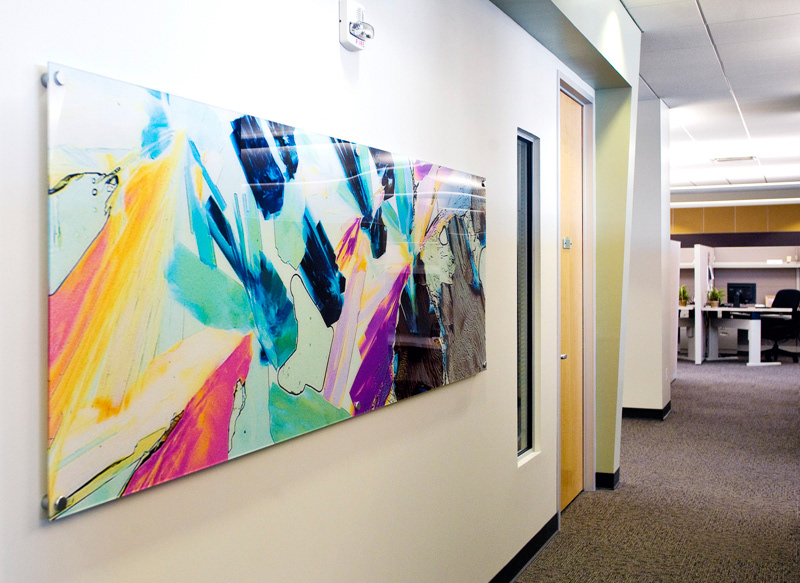
Not every moment in the installation demanded scale. This acrylic-mounted photomicrograph panel demonstrated how the design language worked at a quieter register. Vivid and abstract, the image carried the same scientific source material as the large-format murals elsewhere in the space, but in a format more akin to a gallery piece than a wall installation. Mounted on standoffs, it floated slightly off the surface, catching light along its edges and giving even a standard office hallway a considered, curated quality.

Manufacturing panel - pharmaceutical production process, acrylic-mounted
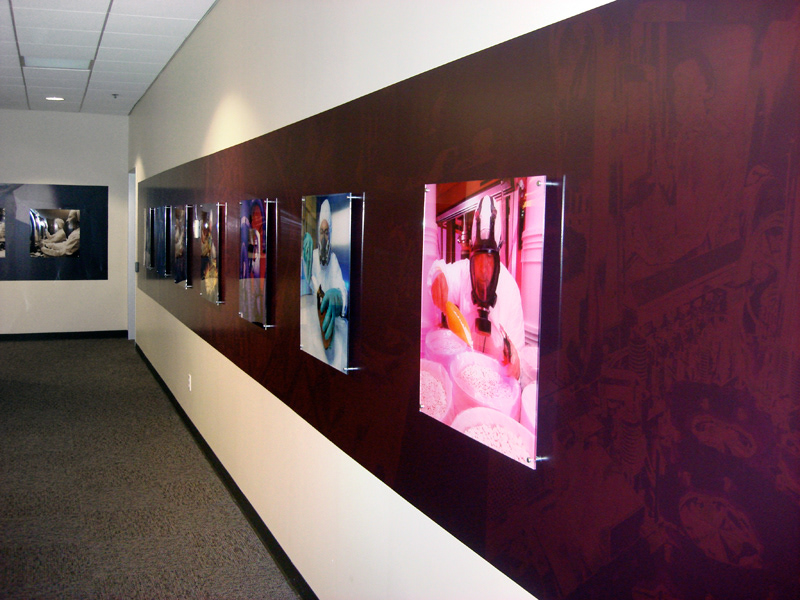
This image stopped people. A researcher photographed from inside a pharmaceutical manufacturing vessel, gloved hands scooping compound through a circular access port, protective eyewear, full clean-room gear, was the kind of photograph most employees had never seen and would never otherwise encounter. The panel felt less like corporate communications and more like visually arresting photojournalism.
Photomicrograph panel grouping, acrylic-mounted
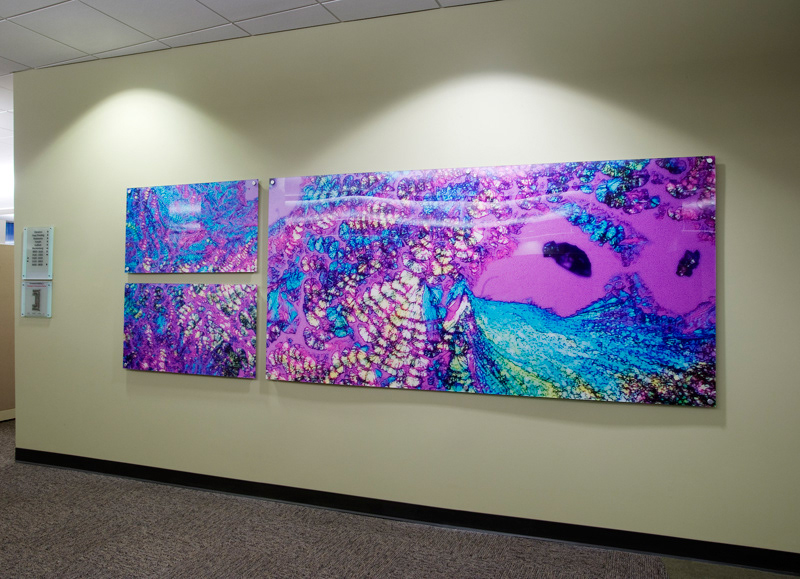
A grouping of three acrylic-mounted photomicrograph panels transformed a plain wall into a gallery moment. The largest panel showed cellular or crystalline structures at microscopic scale, their organic forms flowing across the surface like a topographical map of an alien landscape. Two smaller panels to the left carried companion imagery in the same palette, creating a considered triptych arrangement that gave the wall visual hierarchy without requiring symmetry.
Large-format photomicrograph panel, acrylic-mounted
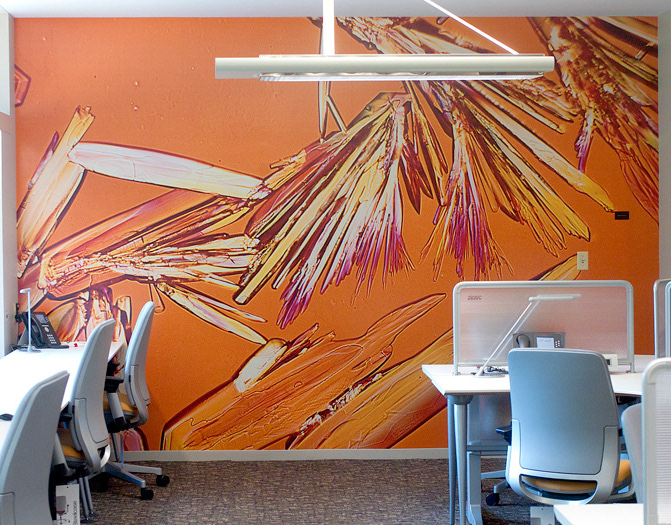
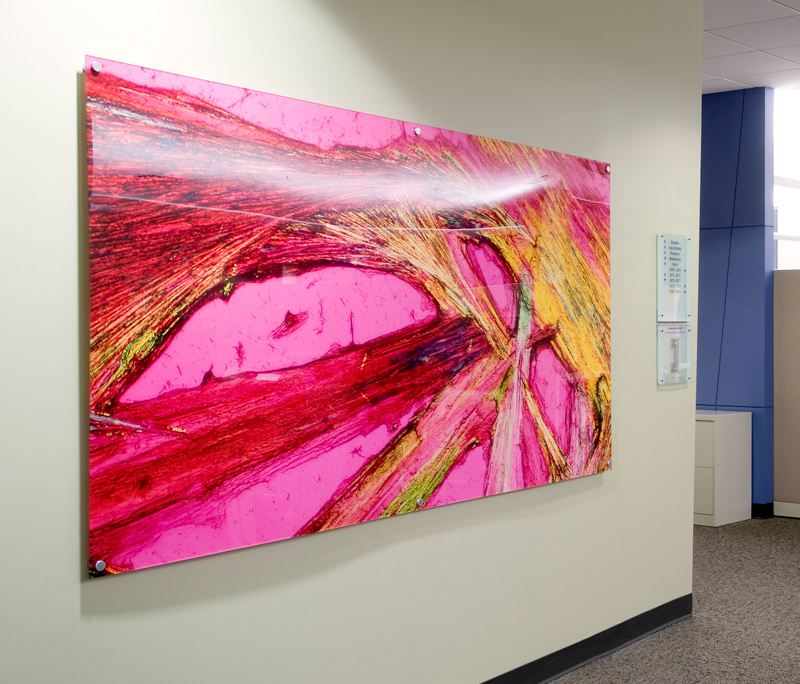
At this scale and in this palette, the photomicrograph was pure painting. The image was simultaneously scientific and abstract: a pharmaceutical compound rendered so far beyond its actual scale that its identity as science dissolved entirely into something visceral and beautiful. This was the installation's quiet argument, made over and over in every corridor and every room: that the science at the heart of this company was not just important, it was magnificent.
Early workers, archival photography montage with dimensional panels
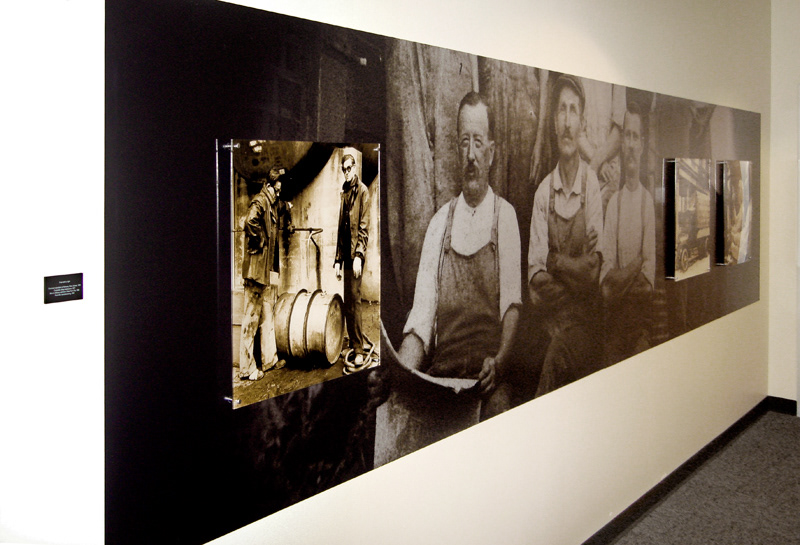
This wall slowed people down. A full-length sepia-toned photographic montage of early company workers (tradesmen, laborers, and craftspeople from the company's founding era) stretched the entire length of the corridor in a single continuous composition. The figures were photographed with the unselfconscious directness of late nineteenth and early twentieth century portraiture: work clothes, barrels, tools, the physical evidence of an industry being built by hand. Two acrylic-mounted dimensional panels floated off the surface at intervals, adding the same layered, curatorial depth seen throughout the installation.
Period pharmaceutical bottles
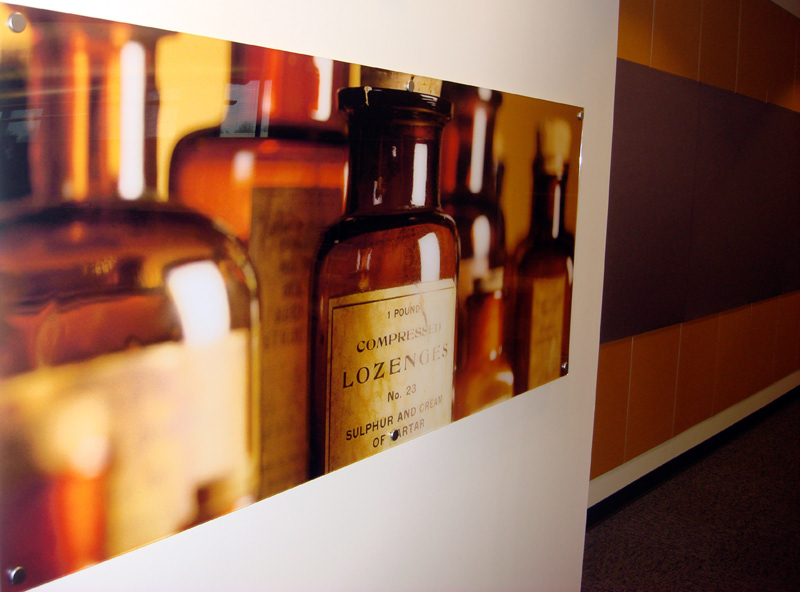
Up close, the installation revealed moments of quiet specificity that rewarded the employee who paused. This acrylic-mounted panel depicted a collection of period pharmaceutical bottles in deep amber glass, one centered and sharply in focus. The image was chosen not for its visual drama but for its historical intimacy: a single artifact from the early days of pharmaceutical production, magnified to a scale that made its age and craftsmanship impossible to miss.
Global responsibility panel - children, acrylic-mounted adjacent to reception lounge
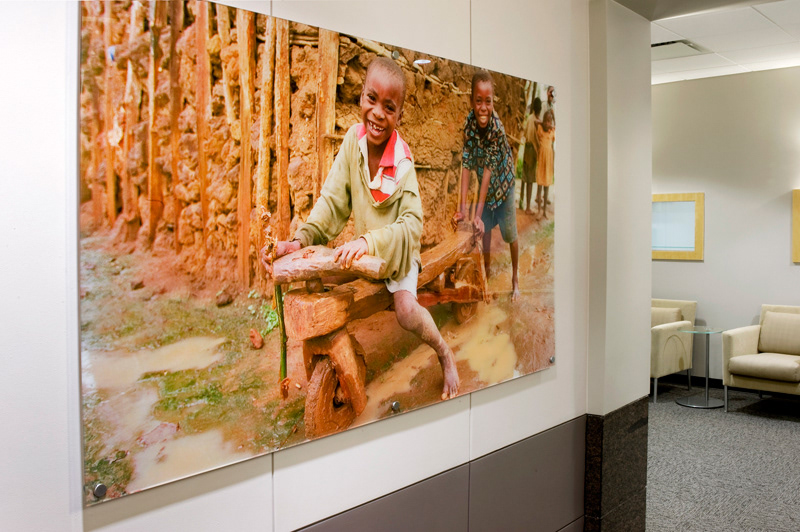
This panel delivered the installation's most human moment. A large-format photograph of two children brought the company's global responsibility work into focus with a directness that no corporate language could replicate. The image required no headline, no caption, no explanation. It communicated what the company's humanitarian programs ultimately were for.
Macro product mural with dimensional manufacturing and people panels
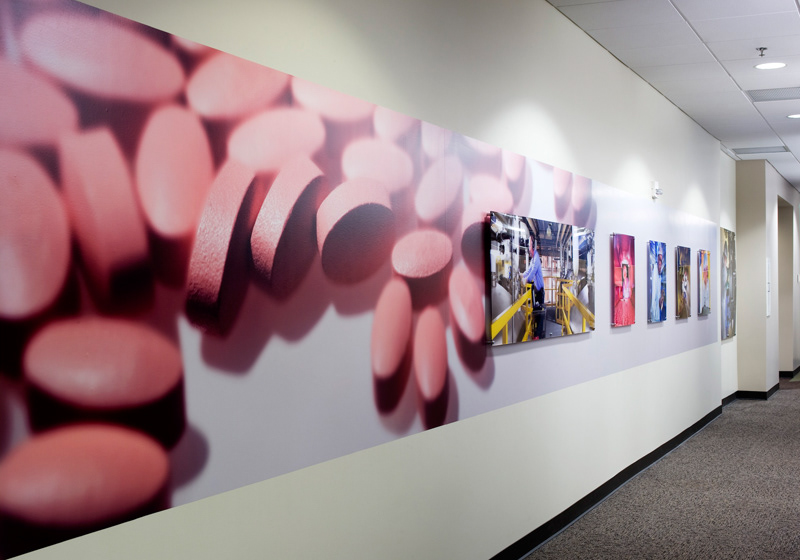
A full-length wall mural of pharmaceutical tablets ran the length of the corridor, transforming the space into an immersive product moment. The tablets were instantly recognizable as medicine yet rendered at a scale that made them feel monumental, almost sculptural. Overlaid on the mural, a series of acrylic-mounted panels receded down the corridor. The combination told the complete manufacturing story in a single corridor - raw product at massive scale on the walls, the human beings who make it mounted in front.
Manufacturing process panels with archival mural
A wall panel ran the length of the corridor, providing a warm, considered backdrop for a series of acrylic-mounted manufacturing process photographs spaced at even intervals — a deliberate curatorial choice that slowed the pace of the space and invited viewers to move from image to image the way they would through an exhibition.