ENVIRONMENTAL DESIGN
Dublin, Ireland: Science as Art, Space as Story
A 135-year-old pharmaceutical company has science at its core, but for most of the people who work there, that science is invisible. It happens in labs, at scales too small to see, behind doors most employees never open.
This environmental design installation for a corporate office in Dublin was built around a single idea: take the science out of the lab and bring it into the space where everyone could see it. Photomicrographs, microscopic images of pharmaceutical compounds captured through a scientific lens, were printed floor-to-ceiling and stretched across curved walls, transforming the invisible work at the heart of the company into something luminous, abstract, and breathtaking in scale. What lived in petri dishes and under microscopes in the lab became the art on the walls. And it turned out that science, seen this way, was spectacularly beautiful.
The project won 7 industry awards, was recognized internationally, appeared on the cover of Graphic Design USA, and was featured in HOW Magazine's 2011 Business Annual.
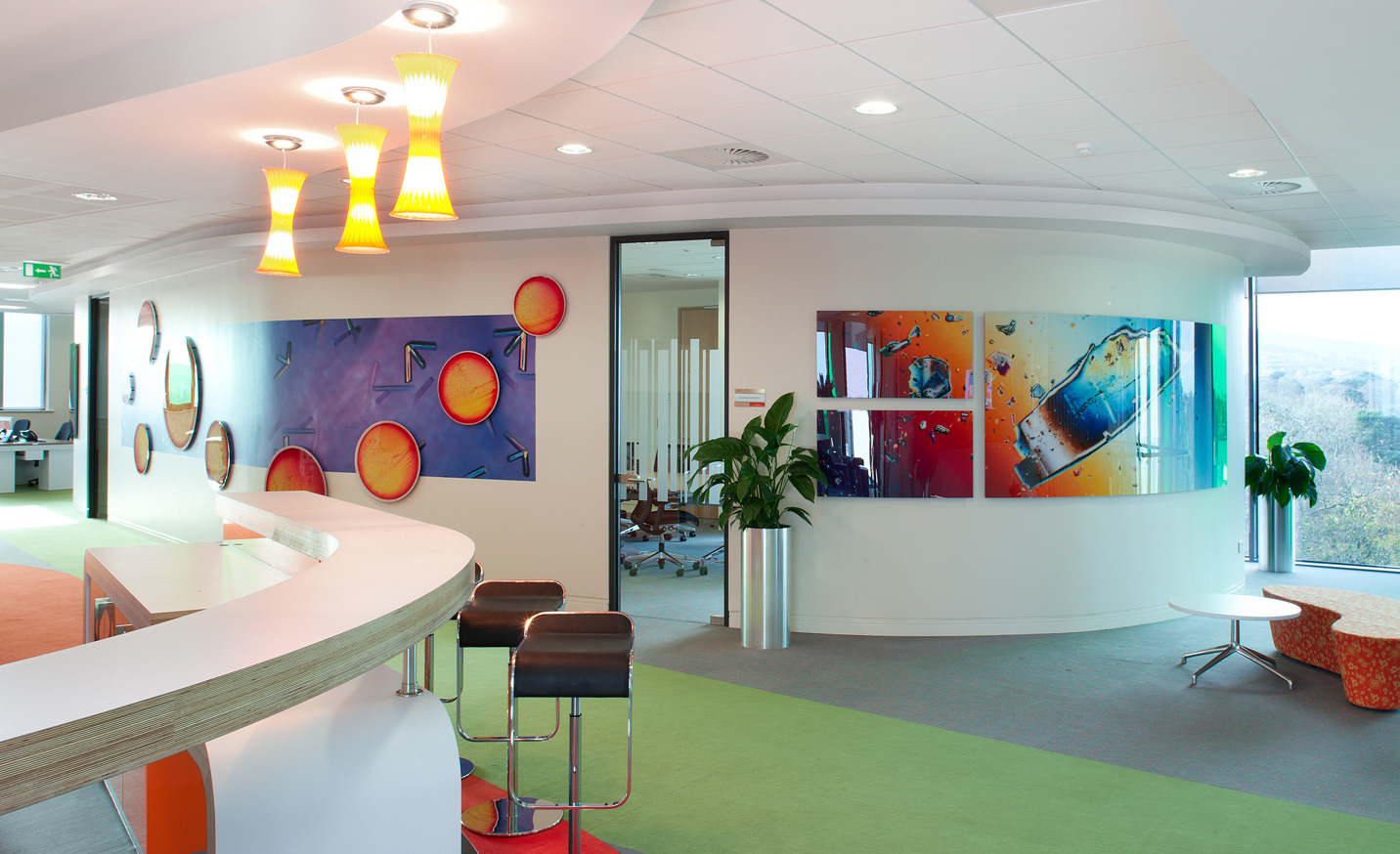
Main collaborative area - photomicrograph wall installations
The first impression of the space established the tone for everything that followed. Plexiglass panels featuring colored photomicrographs conformed to the unique curved walls, while large-format vinyl wall wraps carried microscopic images of an AIDS inhibitor at a scale that stopped people in their tracks. Circular dimensional pieces mounted along the adjacent wall featured cultures within petri dishes - the invisible work of the laboratory, suddenly visible to everyone. The intent was present from the moment you walked in: bring science, the core competency of the organization, out of the lab and into the space where every employee could encounter it daily.
The lighting, fabrics, and floor covering were chosen to seamlessly unite every element into a single cohesive experience. The design language was set at the threshold: this was not a standard corporate office. It was a place that understood what the company was made of, and made it beautiful.
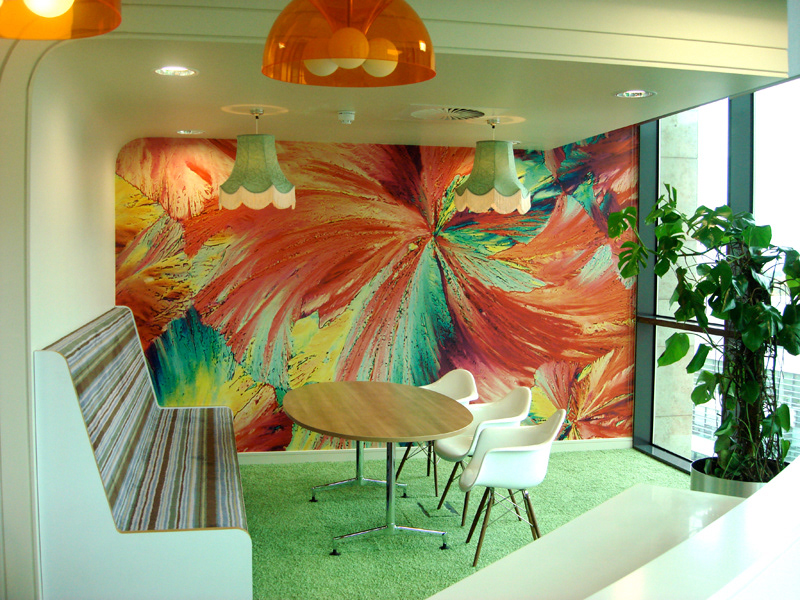
Informal meeting nook - full-wall mural, custom seating
A full-wall mural in explosive botanical abstraction transformed what could have been a conventional corner meeting space into something closer to a living room. The scale of the image was deliberate, wrapping the nook in color and making the act of sitting down to talk feel genuinely different from a conference room. Mismatched pendant lighting in orange and sage completed the space, each piece chosen to complement rather than compete. The green shag carpet extended the botanical reference, grounding the space in something organic and warm.
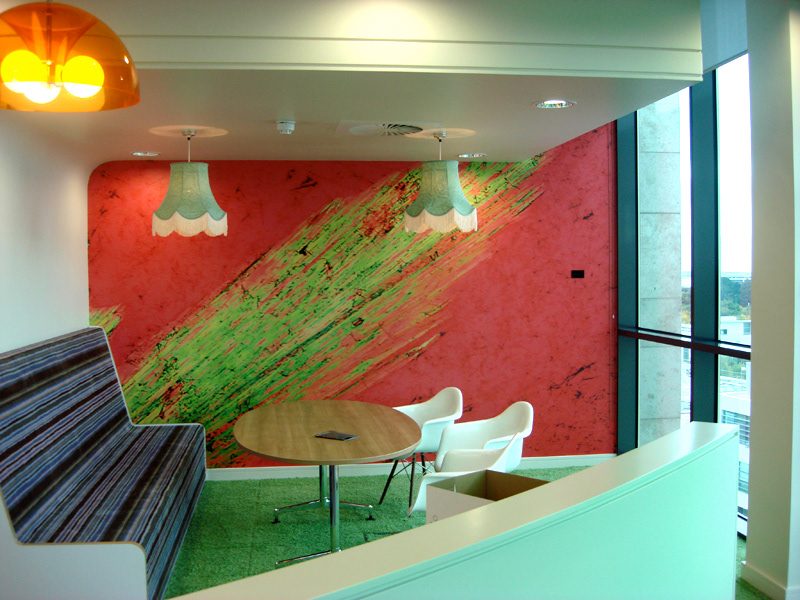
Second meeting nook - diagonal photomicrograph mural
A second nook, same bones, entirely different mood and distinct artistic moment. This installation used a bold diagonal image in coral and acid green to create a sense of kinetic energy. The composition pulled the eye across the wall at an angle, giving a compact space a feeling of movement and dynamism.
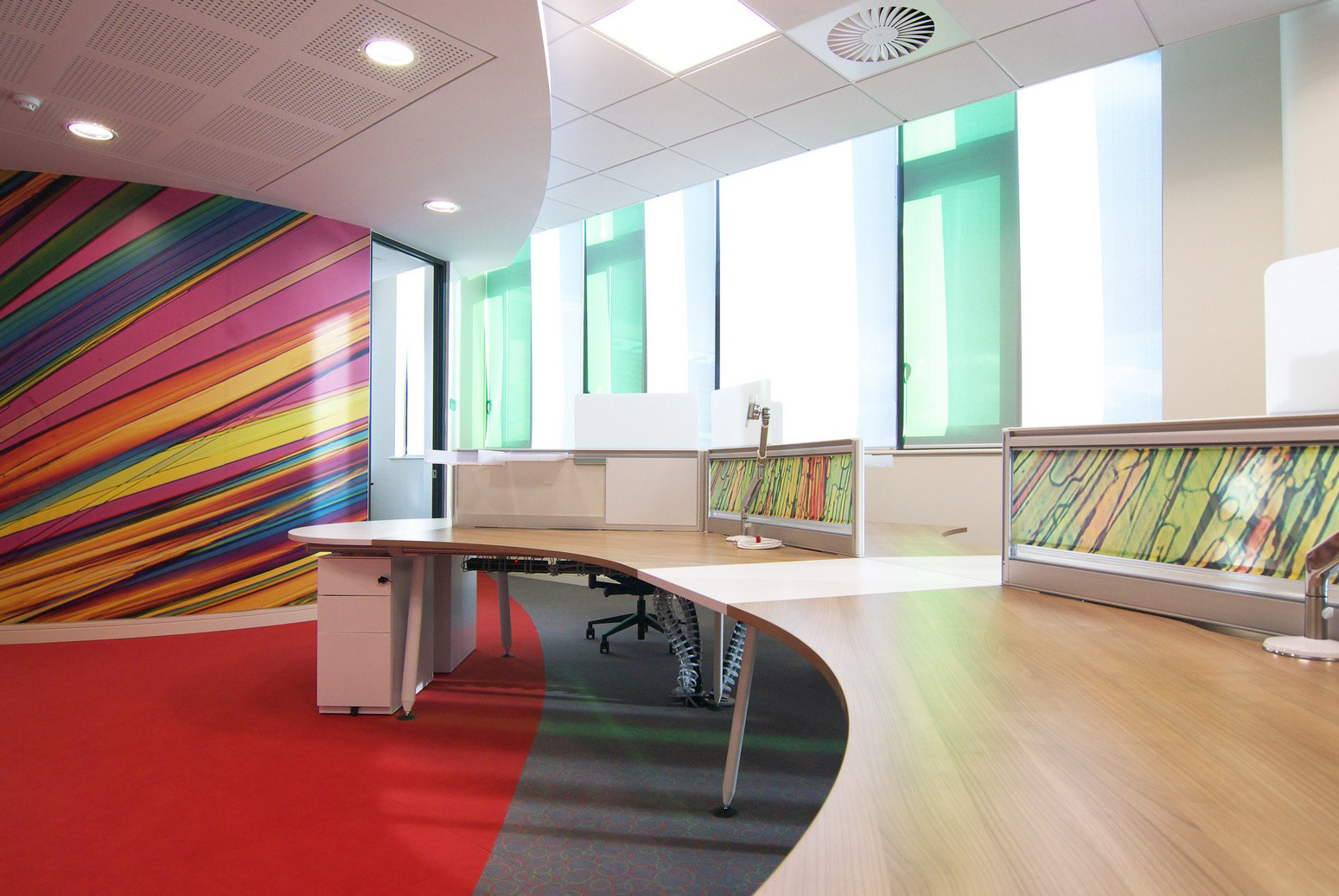
Open workstation area - feature wall mural, printed desk dividers
The installation extended into the primary work area without losing any of its ambition. A full-height feature wall of radiating diagonal color anchored the workstation zone with the same visual intensity as the collaborative spaces. The design didn't stop at the walls: custom-printed graphic panels ran along the desk dividers, carrying the micrograph imagery in greens and reds directly into the work surface itself. The result was a working environment that felt genuinely considered at every scale - from the forty-foot wall behind you to the panel six inches from your monitor.

Full floor view - legacy wall, workstations, and art panels
The full breadth of the installation came into view here. Three distinct design elements worked in concert across the open floor: the abstract art panels along the left wall continued the vivid, large-format photographic language established throughout; the rainbow diagonal feature wall anchored the far end of the workstation zone, visible from every desk on the floor; and between them, a black-and-white photographic history wall carried the company's 135-year legacy - archival images of people, buildings, and moments that told the story of where the organization had been.
The printed desk dividers, red carpet zones, and curved workstation forms completed a floor that operated as a unified composition, every element in conversation with every other, from ceiling to floor to desk surface.

Main corridor - legacy wall and abstract art panels
The corridor was designed as the installation's central narrative spine. Two visual languages ran in deliberate counterpoint along opposite walls: on the left, large-format abstract panels in deep jewel tones rendered at a scale that demanded attention - representing the science and innovation driving the company forward. On the right, a continuous black-and-white photographic timeline stretched the length of the curved wall, archival images of founders, laboratories, employees, and buildings telling the story of 135 years of history without a single word of explanatory copy. Past on one side, future on the other, and the people who connect them walking between.
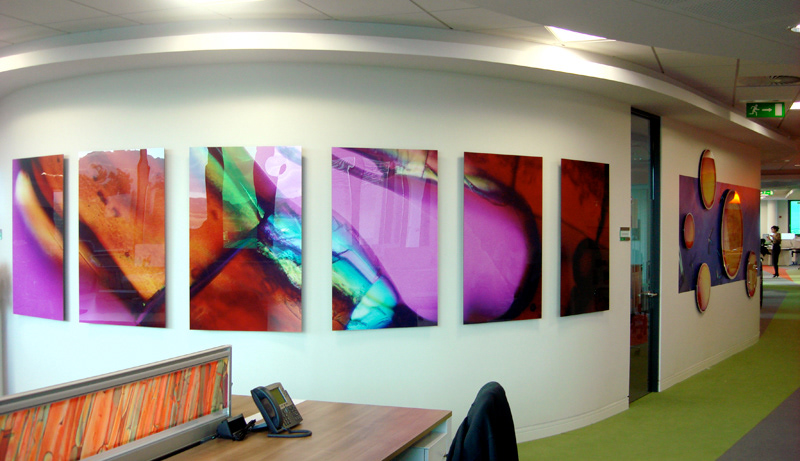
Workstation wall - six-panel series and dimensional wall pieces
Seen from the workstation, the full run of the abstract panel series revealed itself - six large-format prints, each a continuous photomicrograph of a pharmaceutical compound or biological material rendered at a scale that made it unrecognizable as science and unmistakable as art. In the distance, the dimensional circular wall pieces from the main collaborative area came back into view - a reminder that every element in the installation was part of a single coherent system, not a collection of independent decisions.

Open plan floor - full extent of workstation area, art panels, printed dividers
A wider view of the open plan floor showed the full scale of the installation and the discipline required to make it cohere. Across hundreds of workstations, the design system held without becoming repetitive: printed graphic divider panels ran the length of every desk cluster in warm reds and oranges, art panels anchored the walls at intervals in cool greens and teals, and colored light from the window film cast shifting pools of green across the floor as natural light moved through the day. What's most striking in this view is how alive the space felt as a working environment where the design was clearly integrated into the daily rhythm of the people using it, present enough to inspire without being intrusive enough to distract.
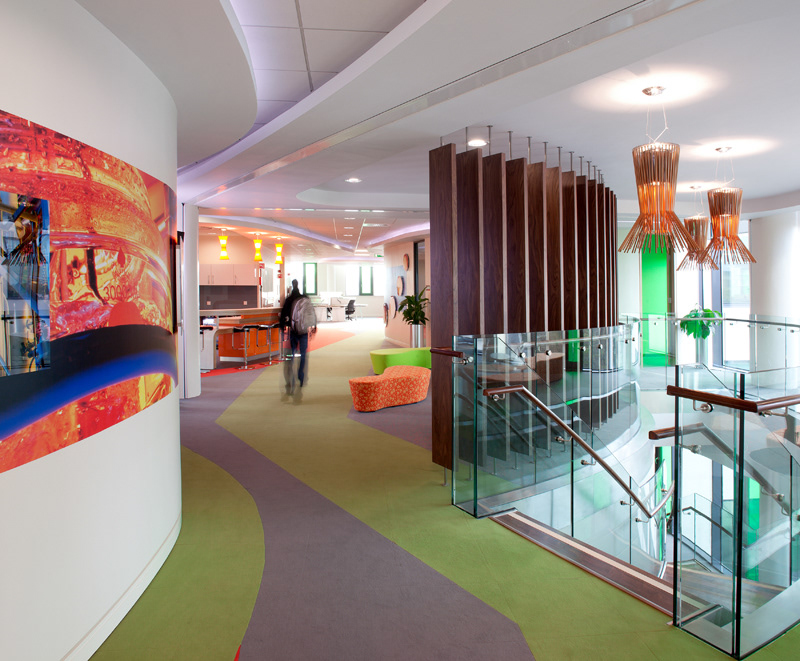
Main circulation - stairwell, flooring, lighting, and art panel
A large-format art panel anchored the left wall, an orange upholstered lounge piece offered a place to pause, and the amber pendant lights visible down the corridor connected this circulation moment back to the collaborative areas beyond.
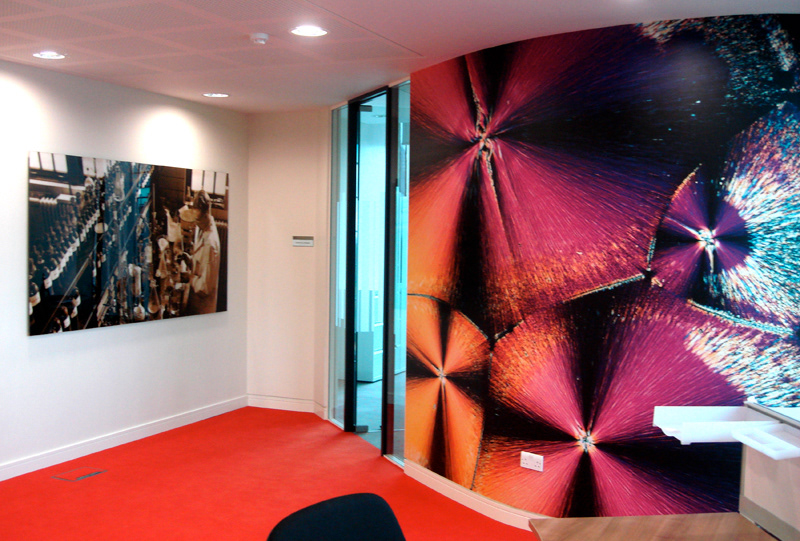
Secondary corridor junction - macro mural and archival photography
Here the installation's core conceptual tension was most explicitly stated in a single frame. On the left wall, a large archival photograph of scientists at work, equipment, and evidence of decades of research represented the company's history in documentary terms. On the curved right wall, wrapping the corner in a full-bleed mural, a photomicrograph of crystalline pharmaceutical compounds rendered in deep magentas, purples, and oranges transformed the science itself into something spectacular.
The same molecules those archival scientists were working with, seen through a different lens entirely - abstract, luminous, and unmistakably beautiful. The juxtaposition was the message: a 135-year-old company whose past and future were equally worth looking at. Past on one wall, present on another, and the connection between them visible to anyone who paused long enough to look at both.

Curved feature wall - large-scale photomicrograph mural detail
Up close, the ambition of the mural work revealed itself fully. This curved feature wall, wrapping a structural column in the heart of the open floor, carried a floor-to-ceiling photomicrograph of crystalline structures in warm amber, terracotta, and cream. At this scale and on this surface, the image ceased to be a reference to science and became something else entirely - a texture worth standing in front of.
A workstation visible in the background provided the scale reference that made the installation's ambition unmistakable: this was someone's everyday view, by design.
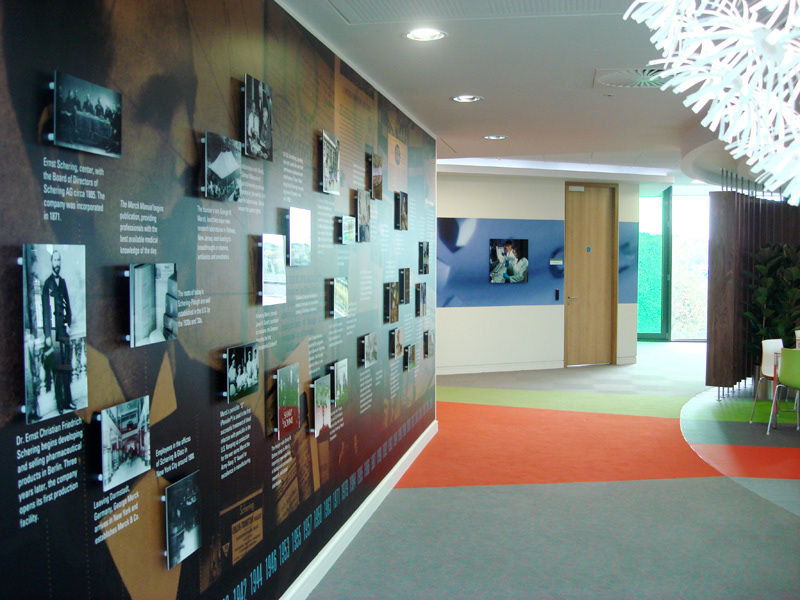
Legacy timeline wall - full corridor view with dimensional archival panels
This was the narrative heart of the installation and one of its most technically intricate elements. A full-length timeline wall stretched the entire corridor, chronicling the company's history from its founding through 135 years of milestones: archival photographs, product images, publication covers, and dated copy mounted on standoffs at varying depths to create a layered, dimensional quality that a flat printed surface could never have achieved. The dark background field made the archival imagery pop with the gravity of a museum exhibition, while the timeline chronology running along the base gave the whole composition a clear reading direction. Dimensional acrylic-mounted photographs floated off the wall surface.
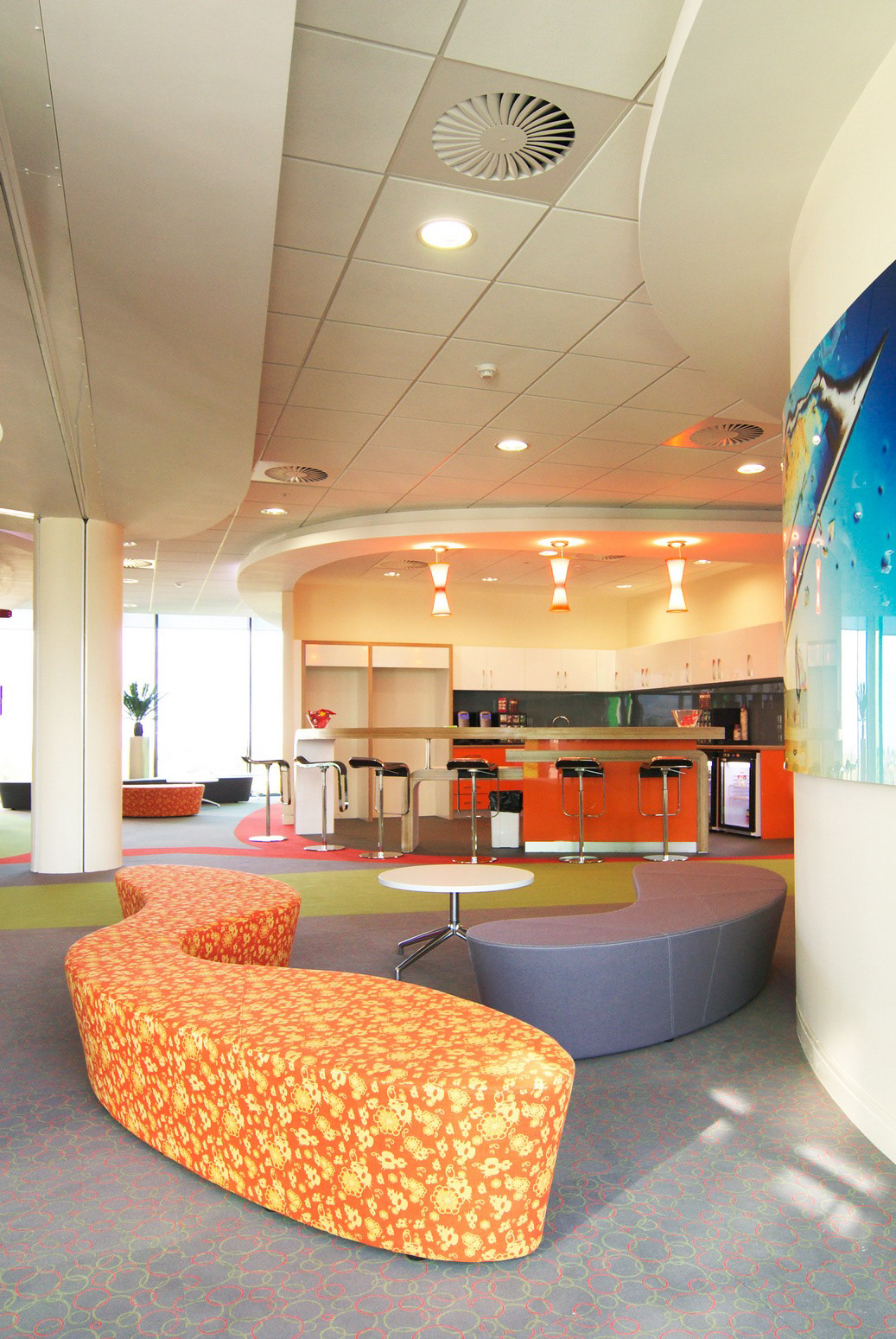
Social hub - kitchen, lounge seating, and communal gathering space
The social heart of the floor was designed to feel nothing like a corporate break room. In the foreground, a pair of curved serpentine sofas in vibrant orange floral upholstery faced each other across a small round table, creating an intimate conversation zone within the larger open space. A large-scale art panel in blue and teal anchored the right wall, carrying the installation's visual language into even the most functional corner of the floor. The cumulative effect was a space that gave employees a genuine reason to leave their desks.