OUTDOOR SIGNAGE & WEB
Avaya: Think Outside The Cubicle Campaign
Most outdoor advertising uses a building as a backdrop. This campaign used one as a prop. The Nasdaq building in Times Square has a distinctive curved facade, and a grid of windows arranged in rows. To anyone who had ever worked in a cubicle, the resemblance was immediate: an entire building that looked like a wall of offices. Workers leapt, flipped, and launched themselves over those windows in a sequence of animations that ran on the building's display in the heart of Times Square. The message: people were breaking free.
Simultaneously, on the Reuters building directly across the intersection, large-format digital displays showed a different kind of liberation: a woman at a café, a man on a sofa, a professional at her kitchen counter, all working productively outside the office, all living the promise of Avaya's Unified Communications technology. "Cut your commute by 100%." "Reinvent the Corner Office." "Change the Way You Work."
The footage captured what no still photograph could fully convey: two of Times Square's most prominent digital displays running in coordinated sequence, the campaign's dual executions visible simultaneously from the same intersection. The two buildings were in conversation, one expressing the energy of liberation, the other showing its destination.
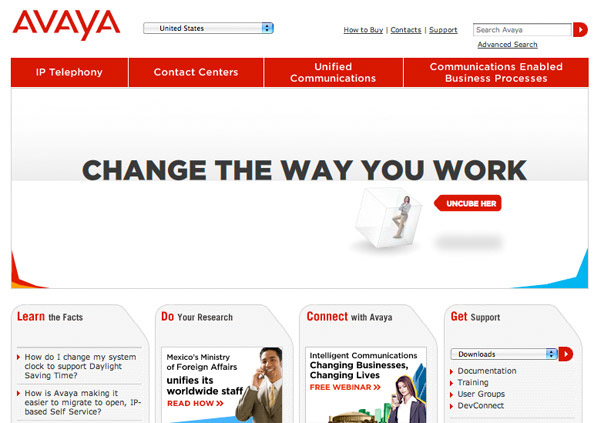
Avaya.com homepage - "Change the Way You Work" with "Uncube Her" as the CTA
The campaign's digital centerpiece lived on the homepage of Avaya.com. "Change the Way You Work" ran across the hero in bold type. Centered beneath it, a tiny figure stood trapped inside a translucent cube - a literal office worker in a cubicle, imprisoned on the most visited page of a global technology company's website. A single red button beside her read "Uncube Her."
One click liberated the worker from her cube, triggering a sequence of animations that presented her and her colleagues in environments outside the office, outside the cubicle, outside the constraints that Avaya's Unified Communications technology was designed to eliminate. The campaign didn't explain what Avaya did. It showed what it felt like to be free of the problem Avaya solved.

Avaya.com homepage — "Reinvent the Corner Office" animation state, café worker
The first animation state after clicking "Uncube Her" delivered the campaign's central promise with a single headline and a single image. "Reinvent the Corner Office", and there she was, the newly liberated worker, seated at a café table, laptop open, fully productive, the world as her office.
The tiny cubicle figure remained visible in the lower left, a ghost of the previous state, a reminder of what had just been escaped, while the lifestyle scene showed what freedom from it looked like in practice.
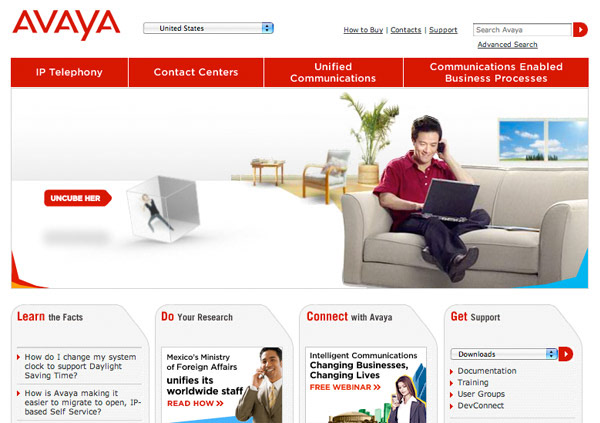
Avaya.com homepage — second animation state, home office worker on sofa
A second state cycled to a different liberated worker - a man on a sofa, laptop open, phone to his ear, fully connected and productive from his living room. Where the previous state represented the freedom of working anywhere in the world, this one represented the freedom of working from home. The animation sequence understood that the aspiration it was selling wasn't just mobility, it was the freedom to choose where work happened, and what it felt like when you got there.

Avaya.com homepage — third animation state, "Serve Your Customers From Anywhere"
The third state shifted the campaign's frame from personal freedom to business capability. "Serve Your Customers From Anywhere." A woman in a headset stood at her kitchen counter, laptop open, fully equipped for customer-facing work from her own home. The headline addressed the business objection the previous states left implicit: working outside the office wasn't just a lifestyle benefit, it was a competitive advantage. The animation sequence had now covered three distinct audiences: the mobile professional, the remote worker, and the customer service representative demonstrating that the "Think Outside the Cubicle" promise applied across roles, and work styles.

Avaya.com homepage — final animation state, product navigation with acrobat figure
The sequence concluded with its most kinetic moment, and its most direct product handoff. An acrobat leapt through the letterspace of the campaign, physically breaking free of the typographic frame as if the headline itself were the cubicle being escaped. Below it, three clear product pathways presented Avaya's core solution set: Streamline Your Business Process, Unify Your People, Rethink Your Contact Center.
The animation had done its job: established the emotional aspiration, demonstrated the lifestyle transformation, and earned the right to make a product pitch. The acrobat carried the campaign's physical energy, the same gymnastic freedom expressed on the Nasdaq building's facade.
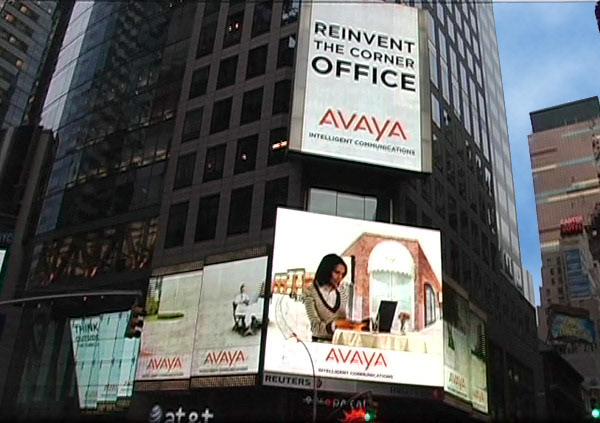
Times Square — Reuters building digital display, "Reinvent the Corner Office"
The Reuters building display brought the campaign's digital headlines into one of the world's most visible advertising environments on the upper board. On the large digital display beneath it, the lifestyle scenes animated in and out. The continuity between the website experience and the outdoor execution was deliberate and precise: a viewer who had clicked "Uncube Her" on Avaya.com and a commuter walking through Times Square were encountering the same campaign moment, the same image, the same headline. The creative system held at every scale.

Times Square — Nasdaq building, Avaya brand state between animations
Between the gymnastic sequences, the Nasdaq building held a clean brand moment - the Avaya logo and "Intelligent Communications" tagline centered on the curved digital surface, the building's grid of windows visible above. The still made the architectural insight of the campaign unmistakably clear: the windows arranged in a perfect grid above the display, each one a cell in a larger structure, uncannily resembling the wall of a cubicle office building.
Both the Reuters and Nasdaq signs created a massive "can't miss it" presence in one of the world's busiest pedestrian intersections.
The campaign was created at R/GA, and it remains one of the most architecturally inventive pieces of outdoor advertising in Times Square history.