ENVIRONMENTAL DESIGN (and then some)
A Museum-Like Lobby, Digital Archives, & Apothecary
Most corporate lobbies say nothing. They process people from the door to the elevator and ask nothing of them along the way. This project started from a different premise entirely: that the daily experience of entering a building could be the most powerful communication a company makes to its own people, and its visitors.
The scope was ambitious. Three interlocking workstreams: a complete transformation of the main entrance lobby into a museum-grade exhibition space; the creation of a global digital archive cataloging over 42,000 assets; and the restoration of a full-scale apothecary.
The result was an environment that stopped people in their tracks and connected employees to a history most of them had never fully encountered.
The Lobby
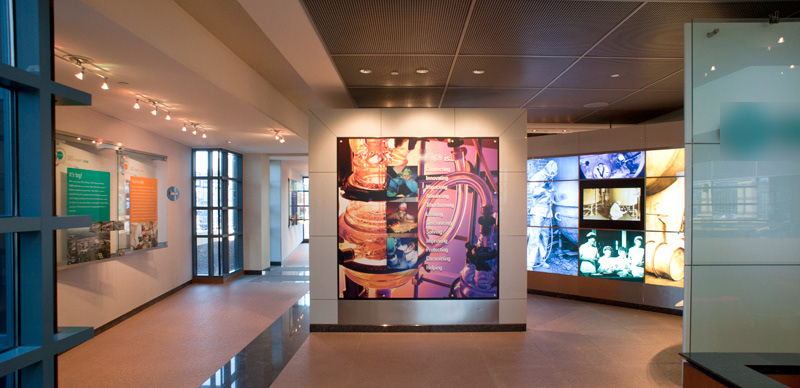
Lobby overview - feature display wall, video wall, and environmental graphics
The view from the entrance said everything about the intention behind the project. A corporate lobby resembling something closer to a museum atrium, a space that told the story of the company the moment you walked through the door. A large-format central display panel anchored the space with a collage of imagery and values copy, flanked on the right by backlit panels with a video in the center running archival and contemporary content.
On the left, environmental graphic panels with editorial copy and photography lined the corridor. Every employee, executive, and guest who entered this building daily was greeted by a space that knew exactly what the company stood for.

Central display panel, video wall, and feature display
Seen head-on, the lobby's three focal elements came into full view. The central display panel combined vivid imagery (pharmaceutical equipment, scientific processes, human faces) with a cascading list of active verbs: Connecting. Innovating. Impacting. Advancing. Transforming. Leading. The language was deliberate, framing the company not by what it made but by what it did in the world.
To the right, the multi-panel wall cycled through archival and contemporary footage, giving the space a living quality that static displays alone couldn't achieve. Between them, an "Innovating" alcove with a sculptural splayed-disc surface invited visitors to explore.

Innovation alcove - "Innovating" themed display with kiosk and photographic panels
Each zone within the lobby was organized around one of the company's defining actions. Four large-format photographic panels spanning the upper wall showed scientists at work solving problems that matter.
A backlit archival image of an early employee anchored the left wall, connecting present-day innovation imagery to the company's founding spirit. At the center, the kiosk surface displayed pharmaceutical products and equipment, fanning outward in a composition that was simultaneously a product showcase and a piece of object-based design - less like a corporate display and more like a well-curated exhibit in a science museum.

Multi-panel video wall - archival imagery
The nine-panel wall gave the space its museum-grade presence. Archival photographs filled each panel in rich duotone treatments of amber, teal, and blue, depicting early employees, industrial equipment, protective gear, and the working conditions of a company in its formative decades. The grid composition allowed individual images to be read as standalone moments or as a single unified tableau. The video wall wasn't static; cycling content kept it alive throughout the day, ensuring that no two visits to the lobby produced exactly the same experience.
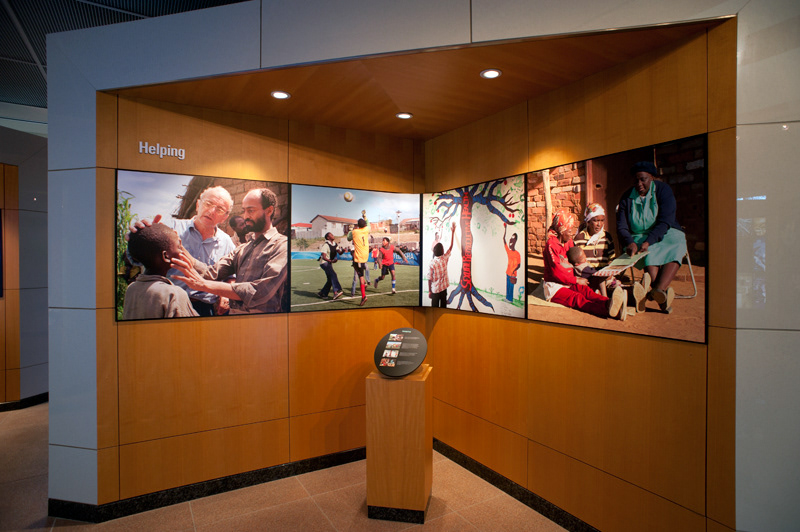
Helping alcove - global impact photography and secondary kiosk
The Helping alcove looked outward at the people the company's work was ultimately for. Four large-format photographs spanning two walls showed the company's global reach in deeply human terms. A small circular secondary kiosk offered visitors a path to deeper content - specific programs, initiatives, and stories behind the images on the wall. Science and service, side by side - the complete picture of what the company believed it was in the world.
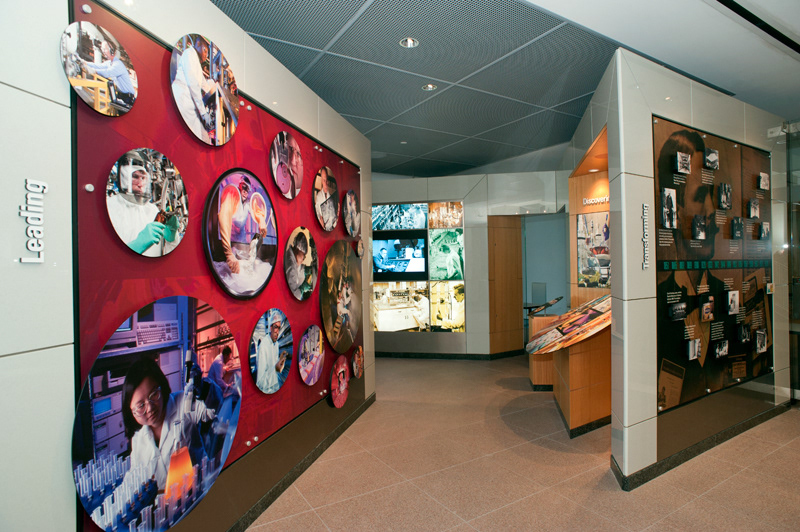
Full lobby corridor - "Leading" wall, "Transforming" & "Discovering" alcoves, and video wall
This view captured the full depth of the installation and made the design system's coherence most apparent. The "Leading" wall commanded attention on the left: a deep red field populated with circular dimensional photographic medallions of scientists and researchers. The circles varied in size, creating a composition that felt energetic and alive. The "Transforming" alcove offered a timeline-style display of milestones and portraiture. The video wall glowed in the background, tying the entire corridor together with light and movement.
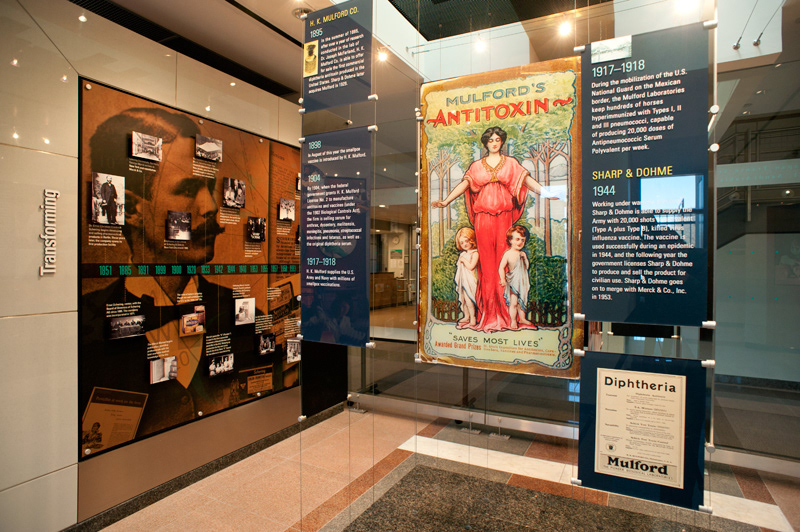
Transforming alcove -heritage timeline, Mulford antitoxin display, and archival artifacts
The Transforming alcove presented the company's origins with the rigor and reverence of a curated exhibition. A floor-to-ceiling timeline panel traced the company's lineage from its earliest decades, with archival photographs, dates, and editorial copy mounted in a layered composition that rewarded close reading. At the center, a freestanding display case presented a full-scale reproduction of a Mulford's Antitoxin advertising poster. Flanking panels carried additional archival material, including a Diphtheria treatment card and Mulford branding from the early twentieth century.
The dates on the timeline traced a company navigating wars, epidemics, and federal regulation in its formative years.
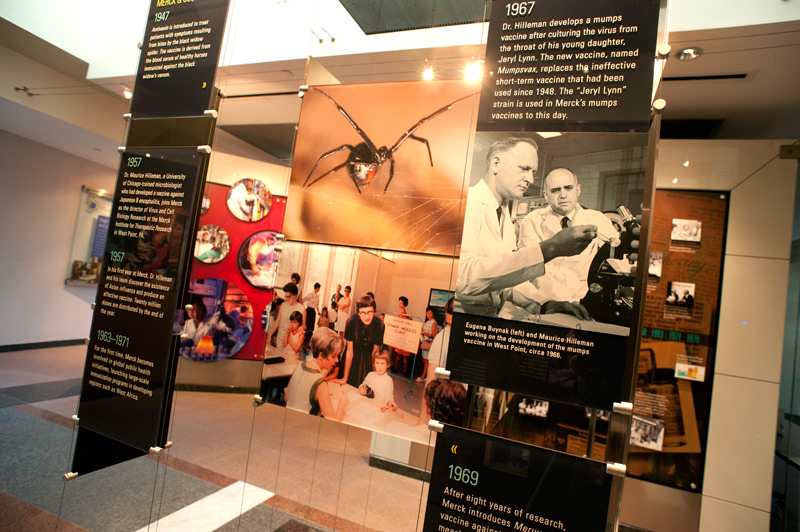
Timeline detail - Dr. Hilleman, mumps vaccine development, and scientific milestones
Up close, the timeline panels revealed the extraordinary specificity of the history being told. The 1967 entry documented Dr. Hilleman's development of the mumps vaccine, cultured from a virus sample taken from his daughter Jeryl Lynn. An archival photograph of Eugene Buynak and Dr. Hilleman working together at West Point in 1966 gave the milestone a human face. A dramatic photograph of a black widow spider anchored the visual center of the panel.
The dates marked a period of remarkable scientific productivity, each entry a story worth telling in full.
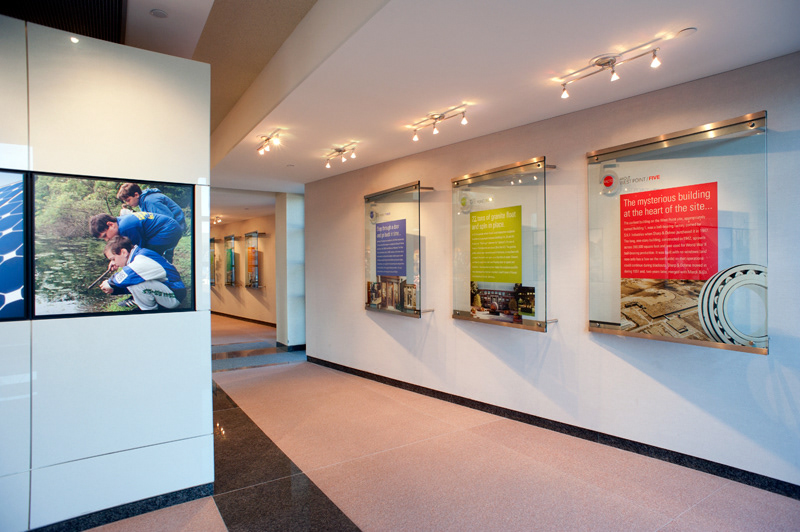
Secondary corridor - framed editorial panels, site history displays, and environmental photography
The lobby experience extended into the connecting corridor, maintaining the same curatorial quality without the density of the main installation. Glass-mounted editorial panels lined the wall, color-coded by subject matter and designed to reward a pause. The sustainable, updateable mounting system meant individual panels could be refreshed as the company's story evolved, without disturbing the surrounding installation. A large-format environmental photograph anchored the left wall, a quiet reminder of the company's commitment to the natural world alongside its scientific mission.
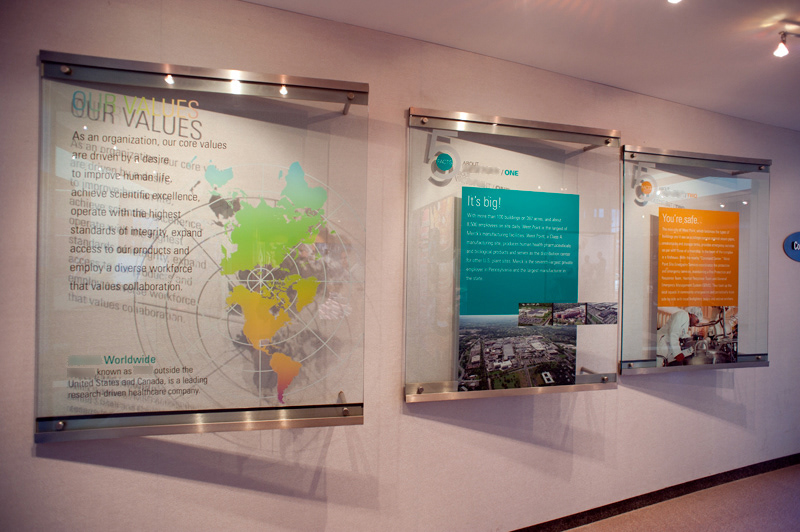
Corridor panels - "Our Values," site facts, and safety culture displays
The corridor panels delivered substance alongside story. The values panel layered the organization's commitments over a global map, connecting written commitments to the worldwide reach of the company that held them. Adjacent panels addressed the scale of the West Point facility and the company's safety culture with the same direct, conversational headline approach. The panel design system (glass-mounted, color-blocked, bold headline typography) made the corridor feel like a coherent publication rather than a series of disconnected displays.
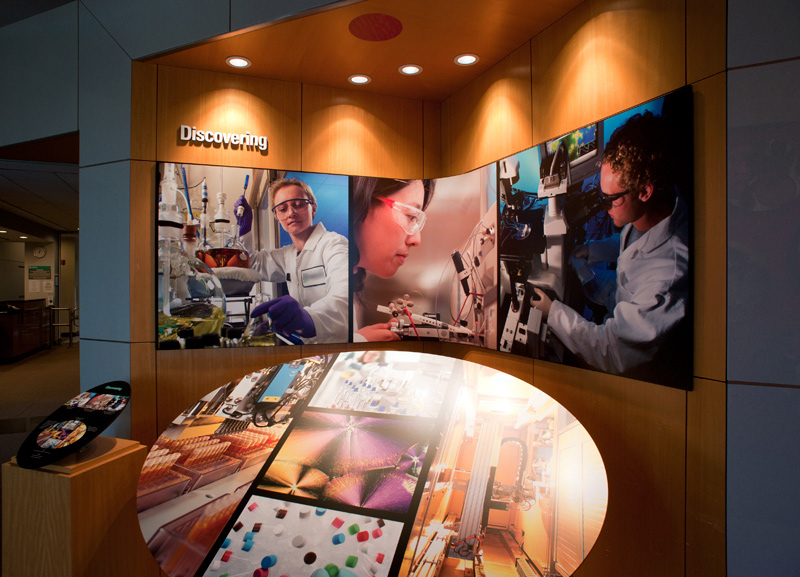
Discovering alcove - research photography and kiosk surface
The Discovering alcove brought the company's present-day research to life. Three large-format panels showed scientists at work in contemporary laboratory settings focused in the act of finding something new. Below, the kiosk surface displayed imagery making the invisible science of the company visible and beautiful.
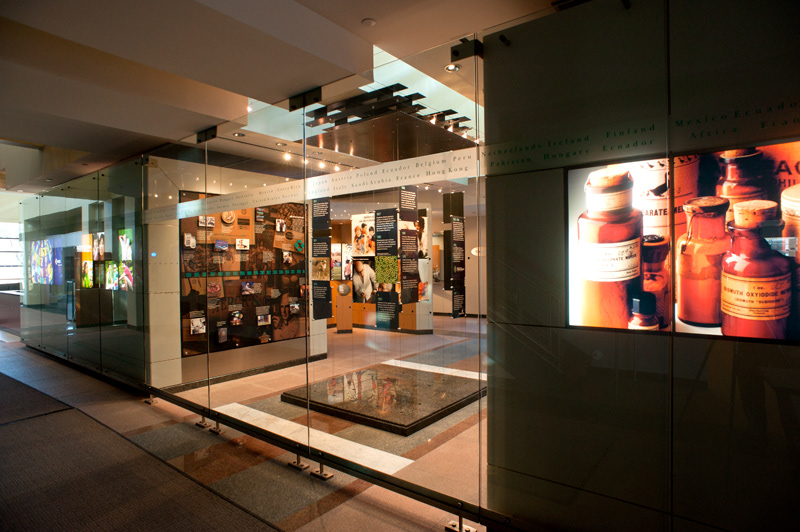
Glass corridor - archival pharmaceutical bottles, and exhibition interior
The transition out of the deeper exhibition space was itself a design moment. Floor-to-ceiling glass walls etched with country names (Mexico, Ecuador, Finland, Ireland, and dozens more) created a typographic threshold communicating global reach. To the right, a large backlit panel displayed antique pharmaceutical bottles - the material evidence of a company compounding medicines for over a century. Beyond the glass, the interior exhibition space opened up: a dense, richly layered installation of archival panels, photography, timelines, and artifacts extending the lobby narrative into a full exhibition environment.
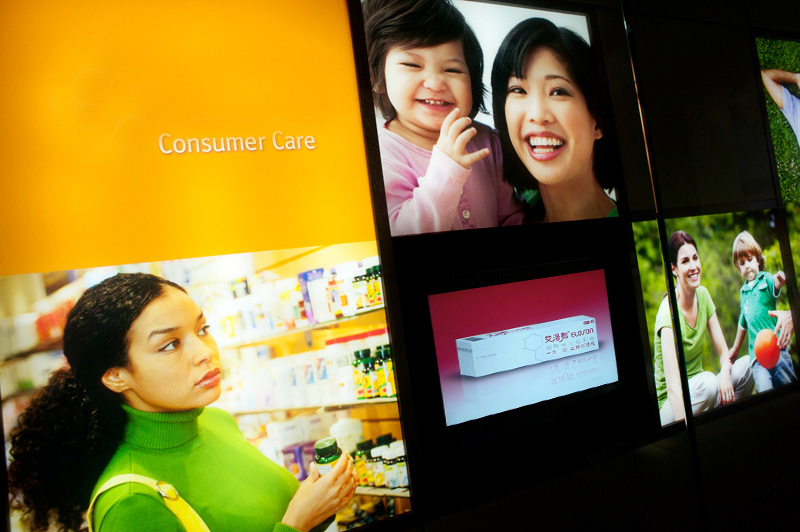
Consumer Care display - product photography, integrated screen, and lifestyle imagery
The Consumer Care section brought the exhibition closest to the everyday lives of the people the company served. Photography told the story of the consumer health portfolio in human terms - a mother and child, a woman making a considered purchase in a pharmacy aisle, a family in good health outdoors. An embedded screen displayed various product packaging samples from the company's Asian markets - a subtle acknowledgment that consumer care looked different in different parts of the world.
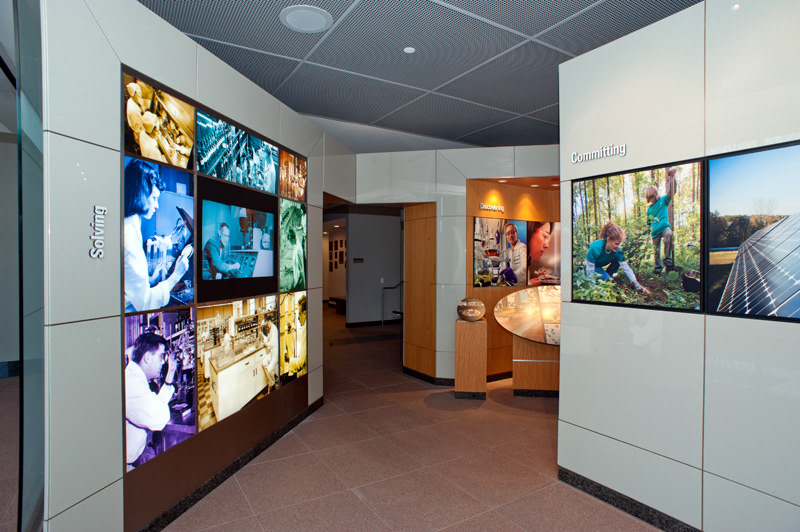
Interior junction - "Solving" video wall, "Committing" panels, and "Discovering" alcove beyond
A deeper view into the exhibition space revealed the full system at work across multiple zones simultaneously. The "Solving" wall presented a nine-panel grid spanning decades of scientific work: scientists, early computers, microscopes, and laboratory equipment. The "Committing" panels carried the company's environmental and community obligations in full-color photography: children planting in a forest, solar panels in an open field.
The Digital Archive
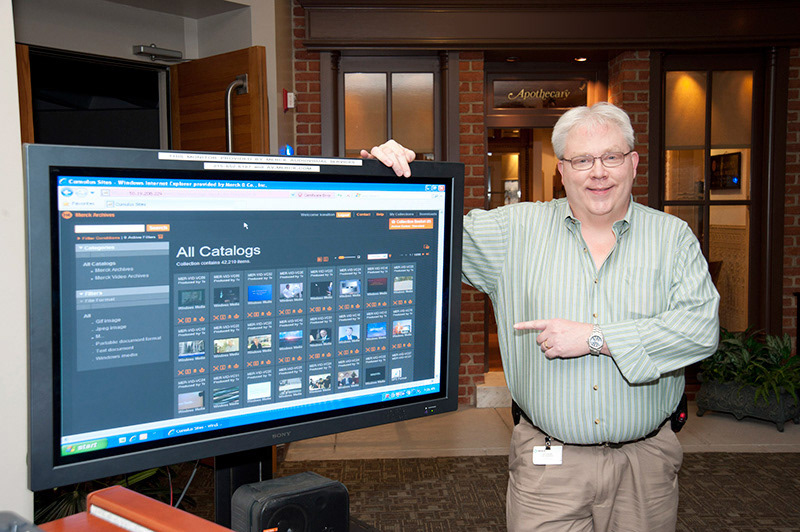
Digital archive launch - "All Catalogs" interface demo with Apothecary entrance beyond
This photograph captured the moment the digital archive went live — a company stakeholder presenting the completed system, pointing to a screen displaying the "All Catalogs" interface with a collection of 42,210 items. The archive was the invisible backbone of the entire project: a globally accessible internal platform bringing over a century of company assets (photographs, video, documents, and media) into a single searchable system for employees worldwide. What had previously existed in scattered physical collections and siloed storage was now organized, cataloged, and accessible from anywhere in the company.

Digital archive in use - multi-screen workstation showing archive interface
Behind the launch moment was months of design and development work, shown here in active daily use. The dark-themed interface displayed organized collections across multiple monitors, with filtering, categorization, and search functionality built for employees who needed to find specific assets quickly across a catalog of tens of thousands of items.
The Apothecary

Apothecary exterior - period storefront facade with costumed guide
Nothing in the lobby prepared visitors for this. Tucked within the building's interior, a full-scale recreation of a nineteenth-century apothecary storefront stopped people in their tracks. The fabrication was meticulous: the brickwork, the architectural molding, the warm glow of interior lighting through the windows - every detail chosen to make the moment of arrival feel like stepping out of a modern corporate building and into the street where the company had its origins.

Apothecary interior detail - period pharmaceutical bottles
Inside, the craft of the recreation revealed itself in every detail. Period glass bottles lined the marble shelf in a row, labeled with tinctures, extracts, and compounds in the typographic style of nineteenth-century pharmacy. These were not reproductions chosen for visual effect alone. They were a faithful material record of what pharmaceutical practice looked like before the modern laboratory.

Apothecary interior - full room view with dispensary cabinet, and period equipment
The full interior of the apothecary revealed the complete scope of the recreation. A floor-to-ceiling oak dispensary cabinet dominated the back wall - dozens of glass-fronted compartments filled with period pharmaceutical bottles, drawers below labeled with their original contents. A brass balance scale stood on the marble counter alongside a mortar and pestle and additional period equipment. A vintage "Prescriptions" sign hung on the wall in period enamel lettering.