ENVIRONMENTAL DESIGN: WORKPLACE TRANSFORMATION
Breaking the Beige
The global headquarters of one of the world's largest pharmaceutical companies had been designed in the 1980s by Kevin Roche John Dinkeloo and Associates, and in most ways, it had remained exactly as built. Cubicles defined the floor plan. Beige defined the palette. Walls blocked the light, divided people, and made collaboration something that had to be scheduled.
Into the transformed space went an installation built from a design language four projects in the making - photomicrograph murals, dimensional research and manufacturing panels, and two pieces conceived specifically for this floor: a fabric structure suspended from the ceiling to create intimacy within the openness, and a ten-foot Cityscape assembling the company's global facilities into a single work of art.
The pilot worked. We learned the building could change, and this was the proof.
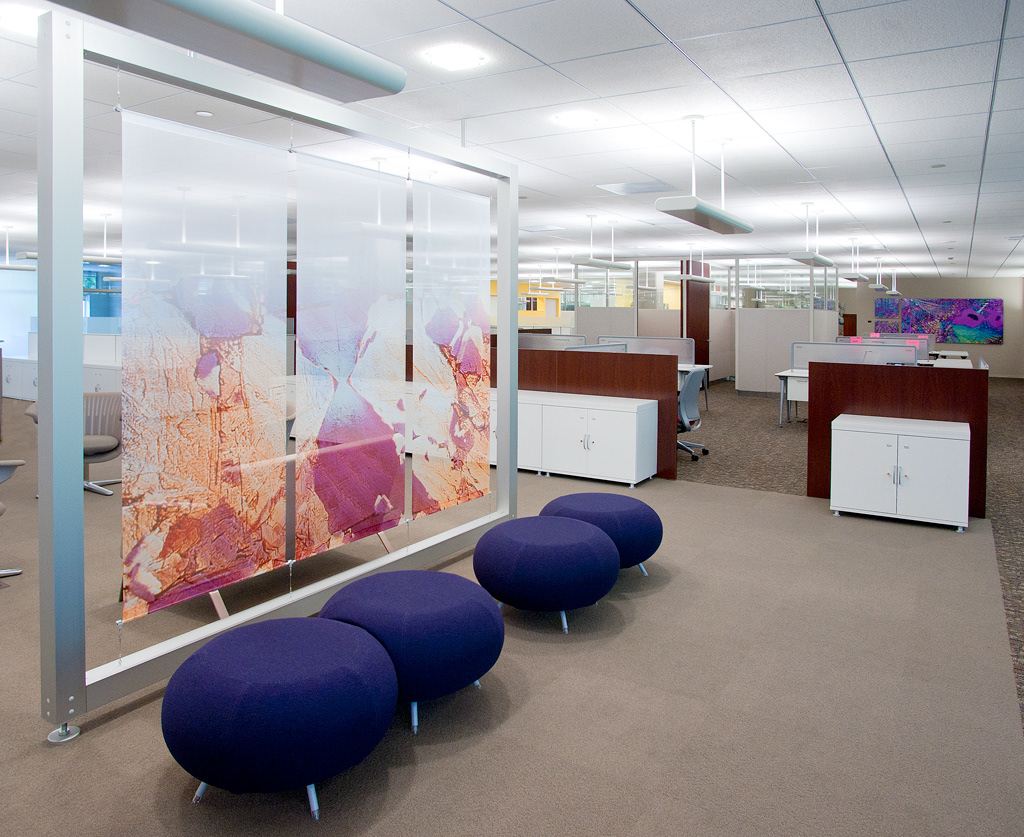
Open plan floor - suspended fabric structure, lounge seating, workstations, and photomicrograph panels
This was what the pilot proved was possible. Where cubicles had once divided the floor into a grid of isolated cells, an open, light-filled workspace now extended to the perimeter. At the center of the space, a Leitner aluminum frame structure suspended from the ceiling (no legs, no floor supports) held custom-printed translucent fabric panels printed with photomicrograph imagery. The structure created a sense of semi-private space within the open floor without closing it off, floating above the carpet like a piece of architectural installation art. In the background, a vivid photomicrograph panel anchored the far wall, carrying the same design language.
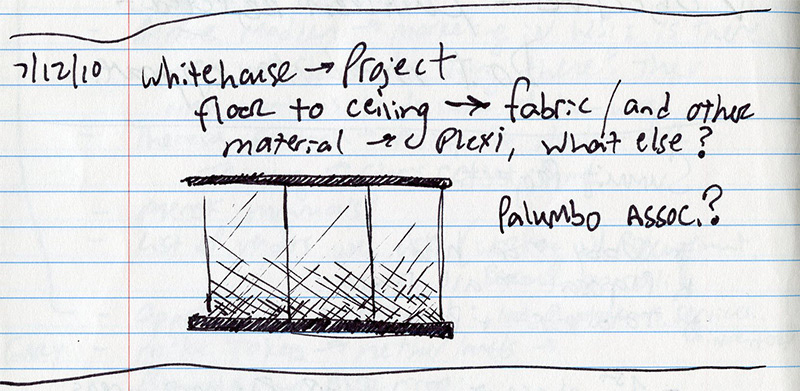
Initial sketch - fabric structure concept
The idea started here. A rough sketch captured the essential concept before a single fabrication conversation had been had. The note "Palumbo Assoc.?" indicated the beginning of the search for the right fabrication partner. This is how the suspended structure began - in a notebook, on a Tuesday, with a question mark still attached to the idea. The distance between that sketch and the finished installation hanging from the ceiling of a global pharmaceutical headquarters is the story of the project.
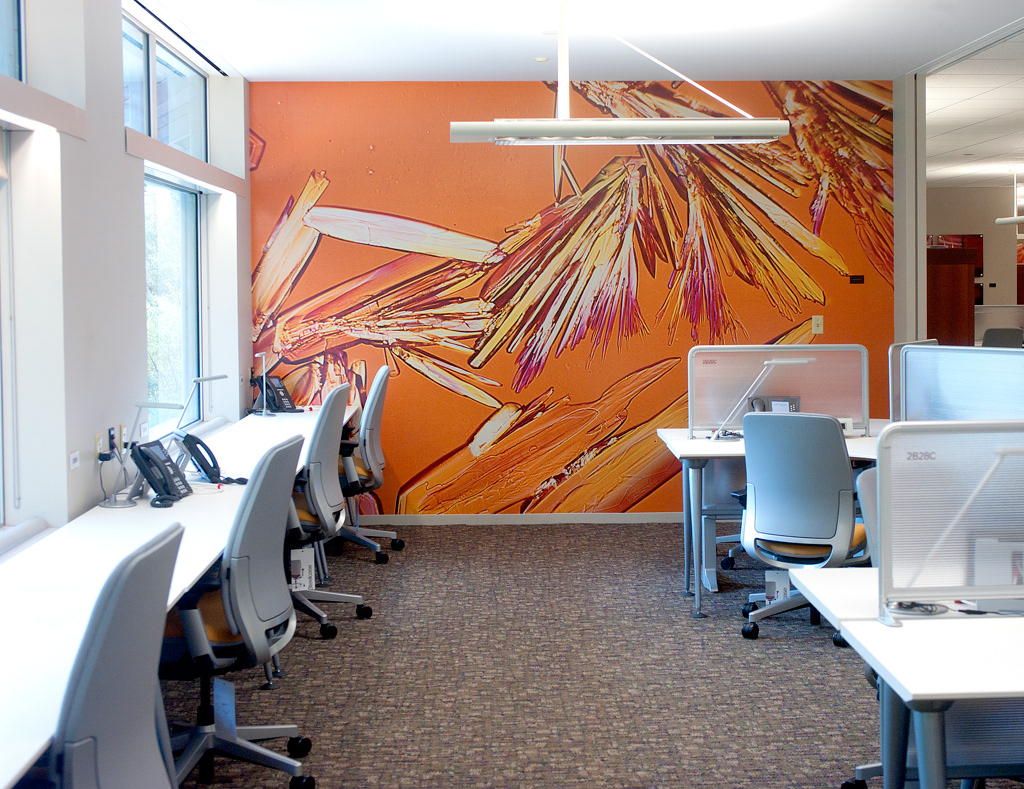
Open workstation area - full-wall photomicrograph mural, natural light
Open benching workstations ran in clean rows. At the end of the room, a full-wall photomicrograph mural filled the entire surface. The mural did two things simultaneously: it gave the workstation area a focal point that drew the eye forward, and it announced that this was a pharmaceutical company's space, defined by the science at its core.

Second workstation area - full-wall photomicrograph mural
A second workstation zone, a second mural, and an entirely different mood. This photomicrograph exploded with energy: vertical striations in blazing reds, oranges, greens, and purples cascading down the full wall like a waterfall of color.
Each workstation zone had its own mural, its own palette, its own character - a design decision that gave different areas of the open floor distinct identities without fragmenting the overall visual language. No two areas felt identical. Every area felt like it belonged to the same space.
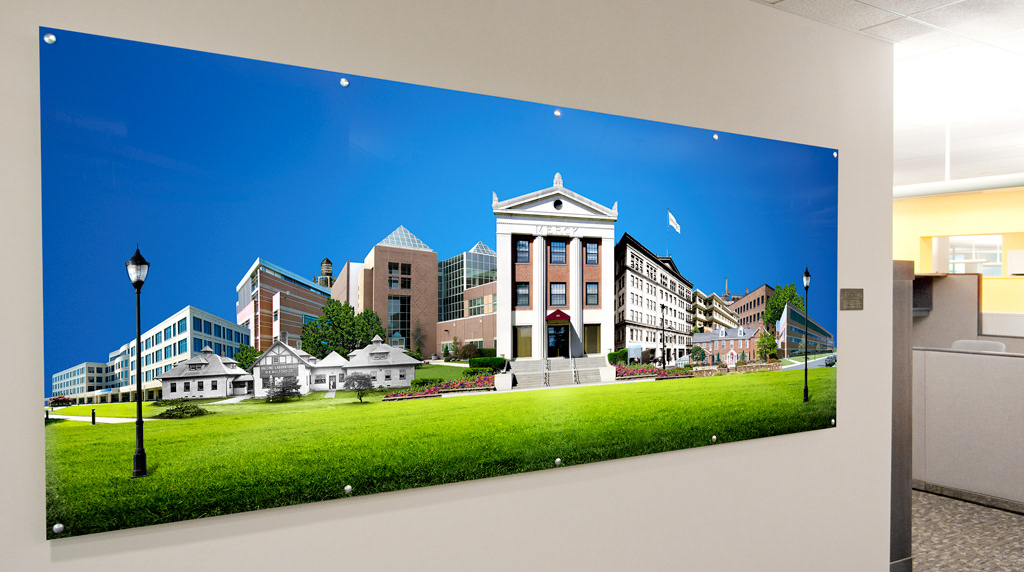
Cityscape - global facilities photomontage, acrylic-mounted
This was the one-of-a-kind piece the space needed. Stretching ten feet wide and four feet tall, the Cityscape was a custom photomontage assembling the company's facilities from around the world into a single continuous skyline - research campuses, manufacturing plants, historic buildings, and modern laboratories composited together as if all of them occupied the same city block. The result was simultaneously a portrait of a global organization and a piece of original art - something that could only exist for this company, in this space.
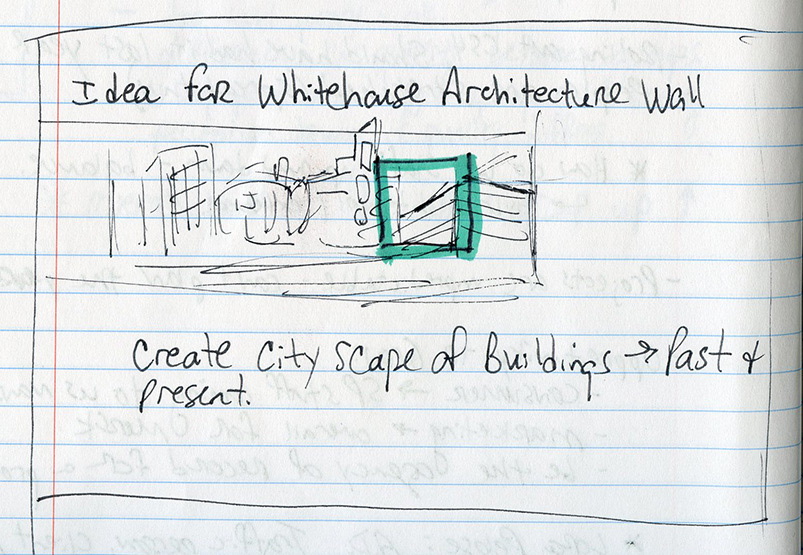
Initial sketch - cityscape concept
The Cityscape concept began in a notebook. A rough sketch showed a horizontal wall panel with building silhouettes arranged in a row. Just enough to communicate the essential concept.
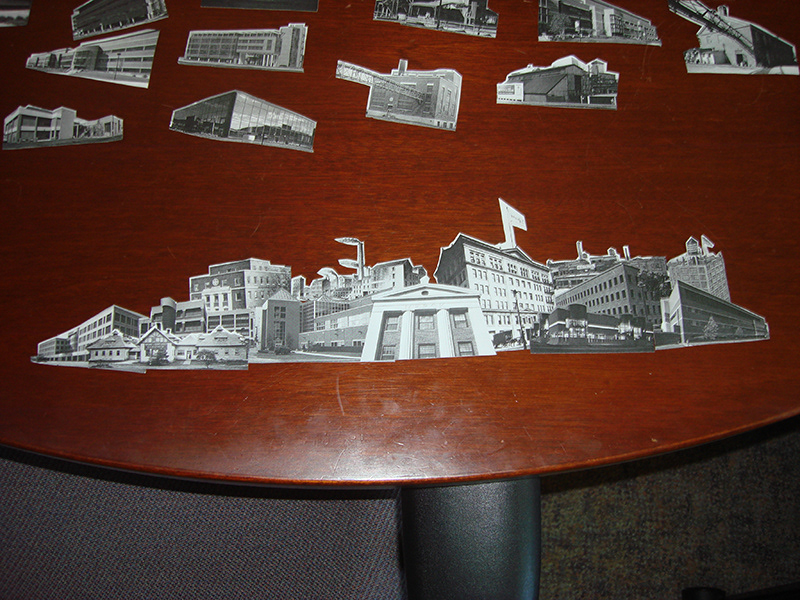
Paper prototype - cityscape composition laid out on a conference table
Before a single pixel was moved in Photoshop, the Cityscape was built by hand on a conference table. Photographs of the company's facilities from around the world were printed, cut out individually, and arranged into a skyline composition - buildings pushed together, pulled apart, reordered, and adjusted until the proportions and rhythm felt right. The result, laid out a desk, already read as a coherent skyline - the classical building prominent at center, smaller structures flanking it on both sides, the whole composition finding its natural balance before any digital work had begun.
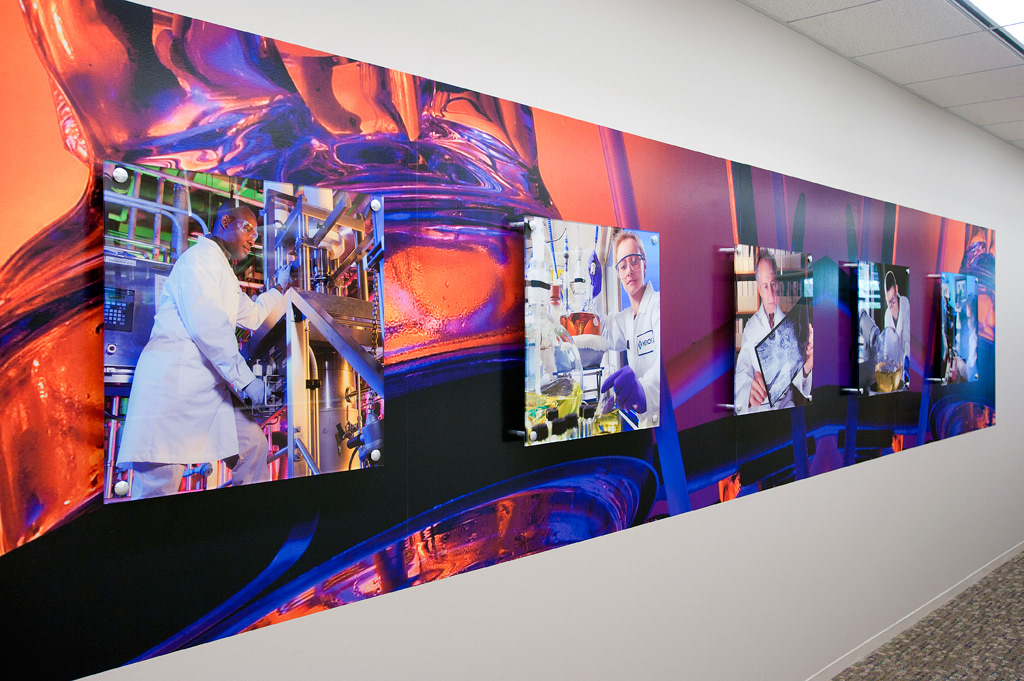
Corridor wall - mural with dimensional scientist and researcher panels
The corridor wall carried the same design approach previously established. A sweeping full-length photomicrograph mural ran the entire length of the wall. Mounted in front on standoffs, four acrylic panels depicted scientists and researchers at work. The juxtaposition was powerful, the invisible science as backdrop, the human beings doing the work in the foreground, but in a global headquarters context, the statement carried additional weight. These were the people working in one of the most consequential pharmaceutical research organizations in the world, their work made visible to colleagues who might otherwise never see it, in a building that had resisted exactly this kind of statement for three decades.
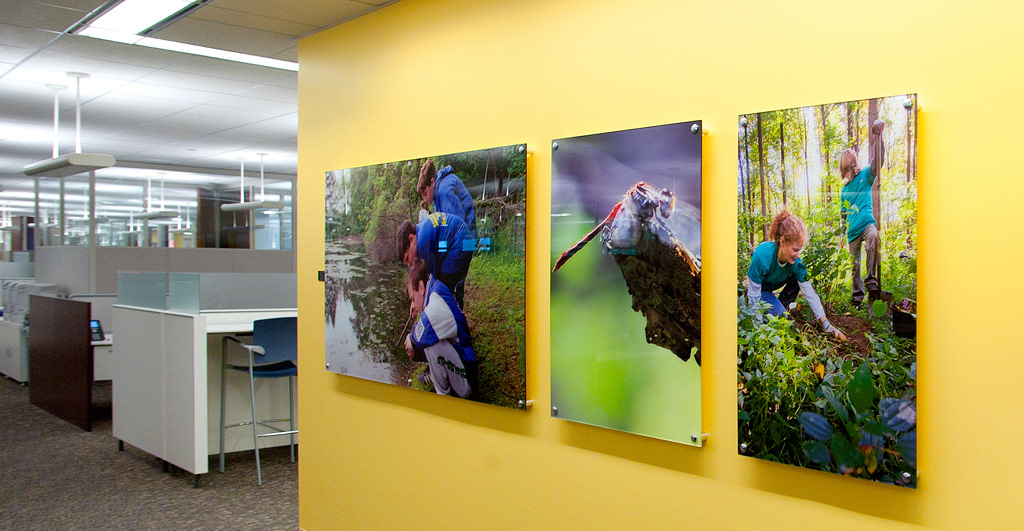
Environmental responsibility wall - triptych panels on yellow accent wall
The final design moment in the pilot was also its most unexpected. A bold yellow accent wall provided the backdrop for a triptych of acrylic-mounted photographs depicting the company's environmental stewardship work. The yellow wall was as much a statement as the photographs it held: color had finally arrived in a building that had been beige for thirty years, and it announced itself without apology.