STREAMING: MOBILE DEVICES
AI-Driven Conversational Discovery
The Pluto TV catalog had grown into tens of thousands of titles. Traditional discovery tools - keyword search, editorial rails, category browsing - were built for viewers who already knew what they wanted.
This initiative explored a different model: let people describe what they're in the mood for, in their own words, and meet them there. Conversational AI, introduced within Pluto TV's existing Search entry point , became the vehicle for testing whether natural language discovery could meaningfully reduce the gap between opening the app and actually watching something
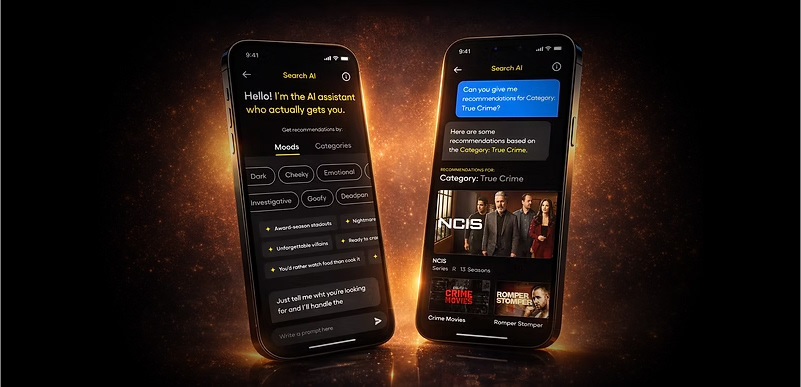
Focus Areas: Conversational AI · Natural Language Search · Recommendation Logic · AI Explainability · AI Product Strategy
Scope: Conversational Search Beta · AI Discovery Prototype · Search & Recommendation Layer · Streaming Catalog Navigation · Emerging Product Capability
Role: VP, Product Design. My role centered on shaping the product design vision, guiding the team, and building clarity around integration and what the experience needed to feel like for it to work. I reviewed all builds and provided feedback to the team for iteration.
Leadership Signals: Early product exploration of AI-driven discovery in a live streaming platform · Integration of conversational AI into an established navigation ecosystem without disrupting existing patterns · Balancing genuine innovation with platform stability
The Problem Worth Solving
Picture this: you open a streaming app after a long day, scroll through rows and rows of thumbnails, and somehow still can't find anything to watch. You know roughly what you're in the mood for - something funny, maybe a little mindless - but the interface keeps asking you to already know what you want.
This wasn't a fringe experience. Usage data confirmed it. A meaningful share of viewers were opening Pluto TV without a specific title in mind, and when they couldn't land on something quickly, they left. As the catalog grew into tens of thousands of titles, the traditional tools: keyword search, editorial rails, and category browsing started to show their limits. They were built for people who already had a destination. Most viewers just wanted a guide.
Conversational AI offered a different way in: let people describe what they're in the mood for, in their own words, and meet them there.
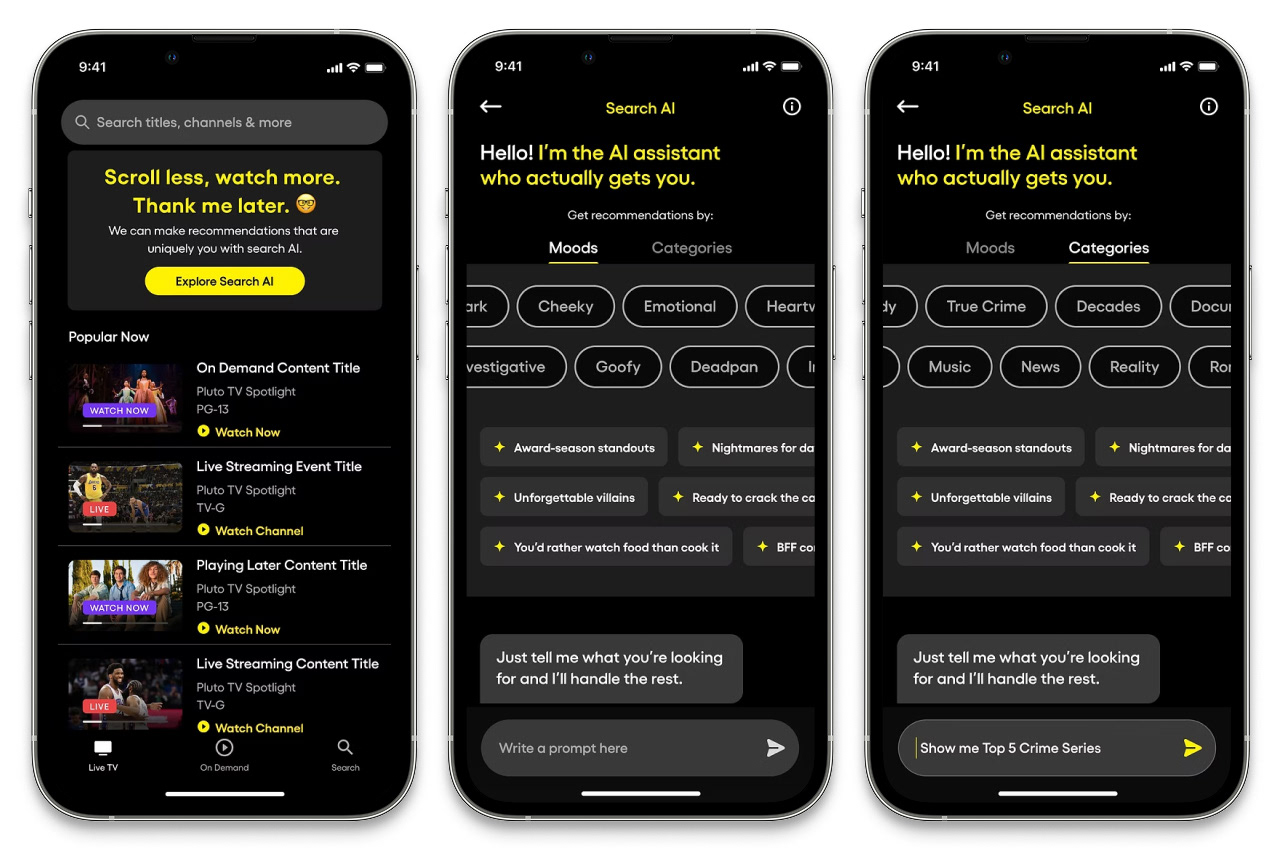
AI search lander. Moods tab. Categories tab
The search lander was redesigned to support three entry modes simultaneously: open-ended conversational input, mood-based browsing, and category navigation. Each path served a different discovery intent, describe their mood, browse by feel, and browse a genre they already had in mind. All three were accessible from the same starting point.
The Approach
Rather than rethinking the entire discovery experience from scratch, the team took a deliberate, additive approach. The conversational assistant was introduced within the existing Search entry point, already familiar territory for users, and a lower-risk surface for validating new behavior without disrupting what was already working.
From there, viewers could express viewing intent the way they actually talk:
• "Show me something funny."
• "I want to watch a crime series."
• "What should I watch tonight?"
• "I want to watch a crime series."
• "What should I watch tonight?"
The system translated those inputs into contextual recommendations by combining natural language interpretation with catalog metadata and recommendation logic. When requests were ambiguous, structured clarification prompts helped refine intent, no reformulating required, just a natural back-and-forth that moved people toward something they'd actually enjoy watching.
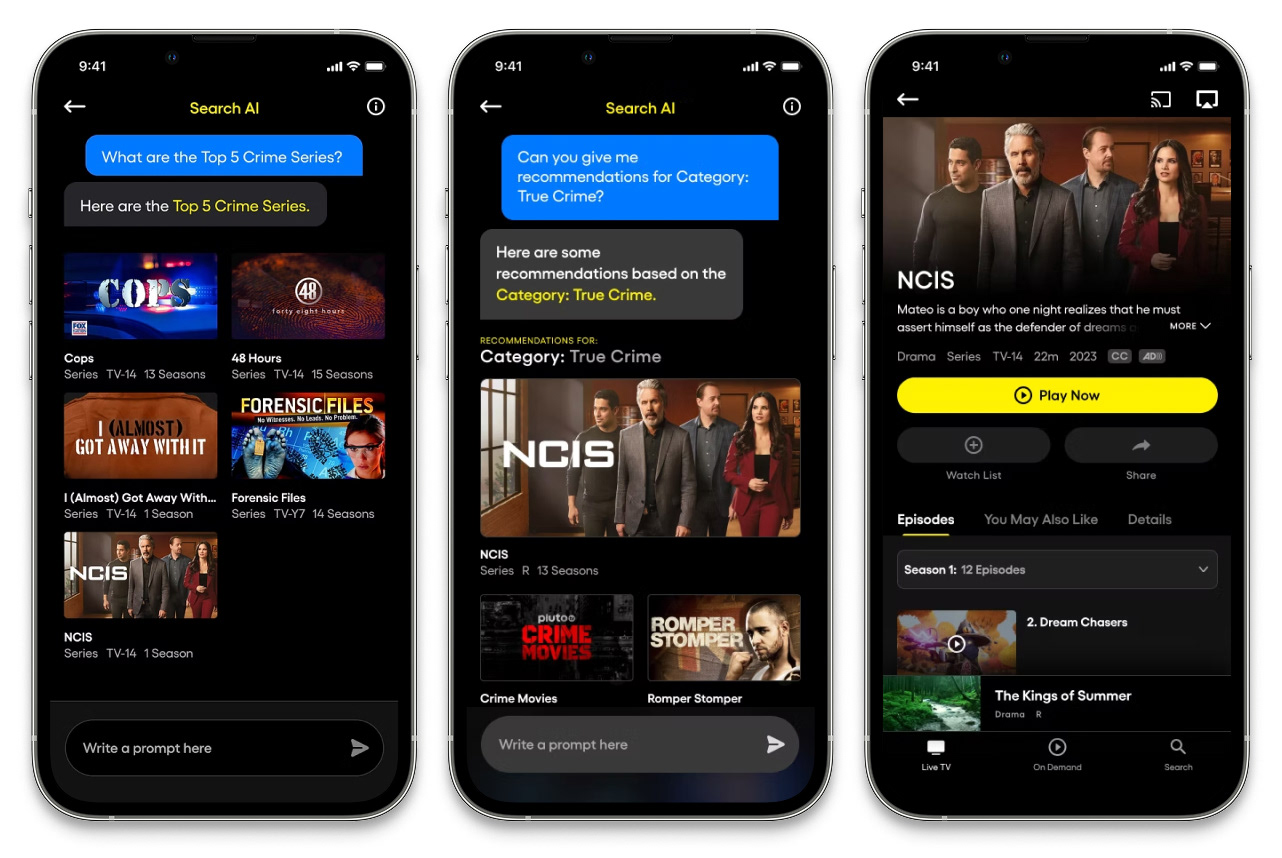
Top 5 results. Category recommendations. Content details
Results were surfaced in ranked order with enough context for viewers to make a confident decision without leaving the search experience. Category-level recommendations gave the system a graceful fallback when a query was broad, narrowing the field without narrowing the options. Content detail was accessible inline, keeping the path from recommendation to playback as short as possible.
Design Principles That Shaped the Work
A few guiding ideas kept the team grounded throughout.
Assist, don't replace. The assistant was built to complement existing discovery patterns, not compete with them. Browsing and keyword search remained intact; this was an additional lane, not a detour.
Build trust through transparency. Recommendation responses were framed clearly so viewers understood why something was being suggested. Unexplained recommendations feel arbitrary. Explained ones feel like a friend who knows your taste.
Balance flexibility with reliability. Natural language is wonderfully open-ended, and occasionally tricky to interpret. Structured prompts and clarification flows gave the system a graceful way to handle ambiguity without putting the burden back on the user.
Speak Pluto's language. The assistant adopted Pluto TV's emerging "Lovable Emcee" brand voice, leaning into light, warm prompts - the kind of thing a charming TV host might say. "Scroll less, watch more. Thank me later." It felt like a natural extension of the platform, not a generic chatbot dropped in from somewhere else.
Surface the full catalog. Recommendations were designed to expose a broad range of titles, not just the obvious hits. The goal was discovery in the truest sense, helping viewers find things they wouldn't have found on their own.
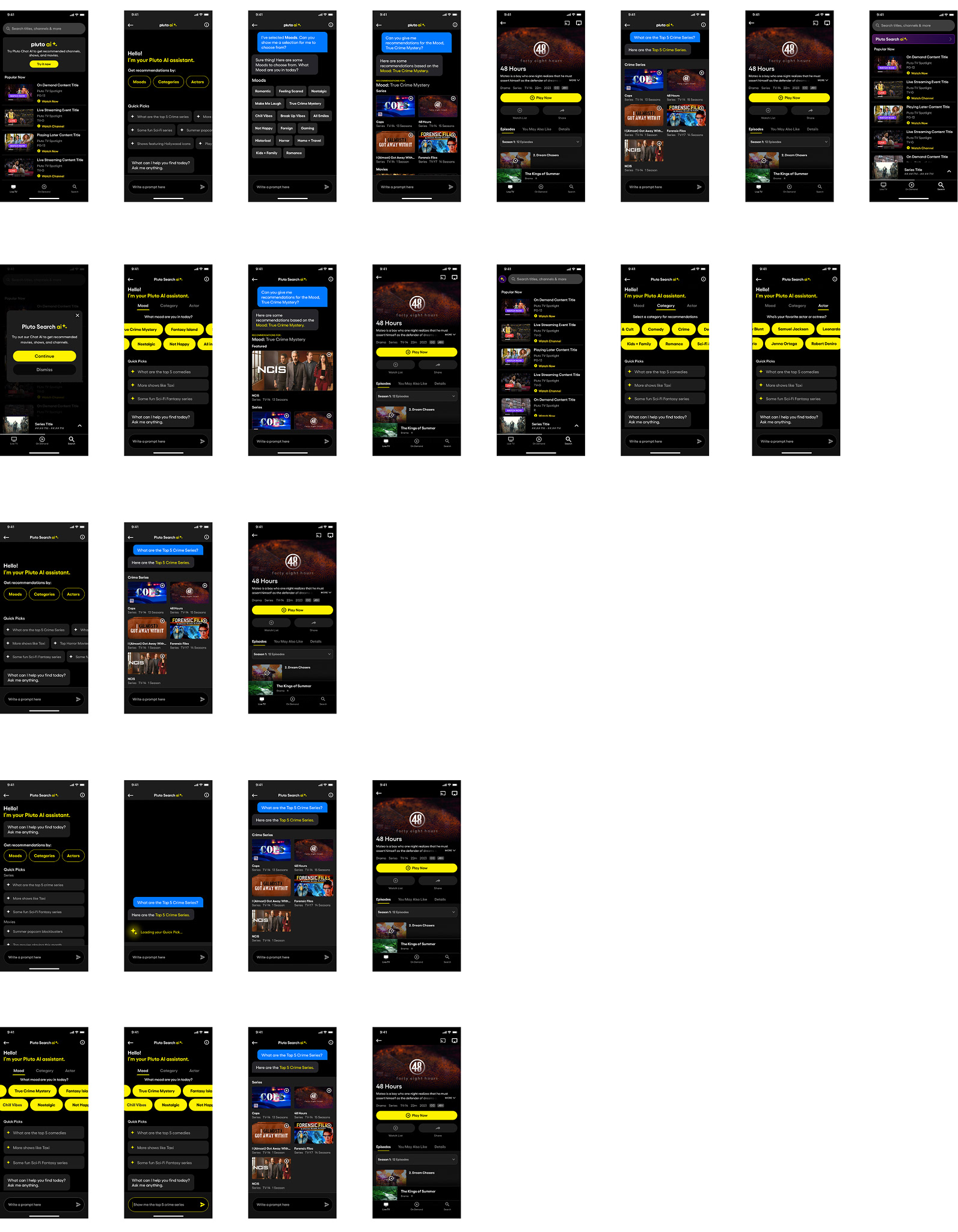
Alternative concepts explored in Figma
The published beta direction emerged from a wider exploration. Alternative concepts were developed and evaluated in Figma, testing different approaches to how the assistant presented itself, how recommendations were structured, and how the experience integrated with existing navigation.
MVP Scope
The initial release was intentionally scoped to test the core behavior: could viewers actually use conversational input to find something to watch, and would they want to?
The assistant supported:
• Natural language viewing requests
• Guided recommendation responses
• Suggestion prompts for common discovery intents
•Clarification prompts to refine ambiguous queries
• Guided recommendation responses
• Suggestion prompts for common discovery intents
•Clarification prompts to refine ambiguous queries
Launching within Search allowed the team to measure engagement without disrupting the broader navigation experience - a meaningful constraint that shaped how quickly the team could move and learn.
What We Learned
The release validated something worth knowing: viewers were genuinely willing to express their viewing intent conversationally, and to follow the assistant's recommendations toward playback.
Users who engaged with the assistant moved from intent to content with less friction than expected. Perhaps more interesting, the system surfaced a wider range of catalog content than traditional browsing typically does, suggesting that conversational discovery could quietly become one of the better tools for helping viewers find titles that wouldn't have otherwise risen to the surface.
Those learnings shaped the roadmap for expanding AI-driven discovery further.